
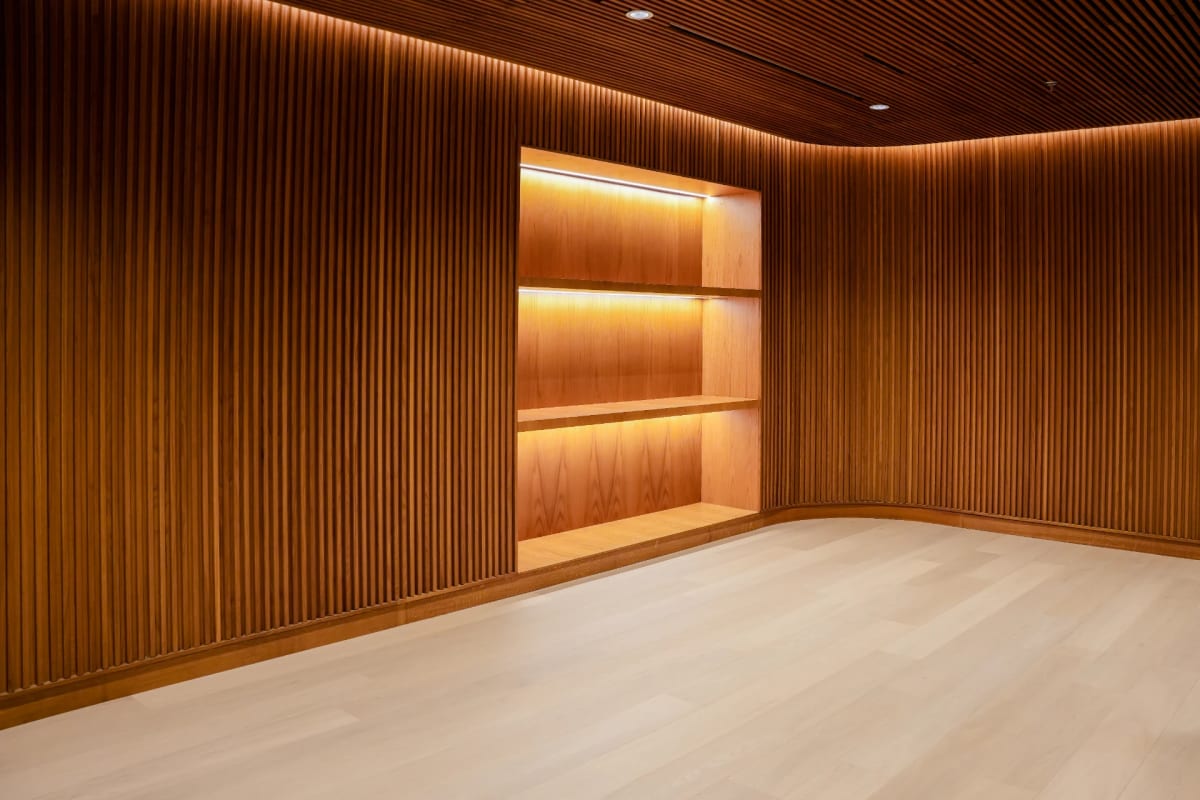
Two panels can look identical on a shop drawing and come out completely different at the workshop bench if they are cut by hand at scale. CNC precision joinery in Dubai closes that gap: a design is translated into a machine-readable file, cut to a fraction of a millimetre, and handed to a craftsperson to finish rather than to first true up. It is not a replacement for skill so much as a way of getting the skilled hours spent on the part of the work that actually needs them, the fit, the finish, the judgement calls a machine cannot make. Used well, it is also how a joinery workshop gets to dubai-it, taking a detail that would be prohibitively slow to produce by hand and making it repeatable across an entire villa or building.
What CNC Precision in Joinery Means
Computer numerical control (CNC) joinery uses a computer-guided router or cutting machine to shape timber, laminate, and board material directly from a digital file rather than a hand-marked template. A joiner's shop drawing is converted into a CNC-ready file that specifies every cut, groove, hole, and edge to a fraction of a millimetre, and the machine executes it with the same accuracy on the first panel as the hundredth. This matters most in three areas: repeatability across identical units such as wardrobe carcasses or kitchen runs, complexity that would be inconsistent to cut by hand such as fluted or curved panels, and detail such as concealed hinge housings that has to align exactly with hardware specifications. Craftsmanship still governs everything the machine cannot do: material selection, finishing, fitting on site, and the final judgement of whether a piece is ready to leave the workshop.
What Dubai Interiors Ask of Precision Joinery
Dubai and Abu Dhabi's interiors place particular demands on how joinery is cut and assembled. Open-plan villas and majlis-style entertaining spaces often call for long, uninterrupted runs of panelling or cabinetry, where any inconsistency in a repeated groove or reveal line is immediately visible across several metres of wall. Constant air conditioning and the region's heat also mean timber and board materials expand and contract more than in milder climates, so cut tolerances and jointing methods have to account for material movement rather than assume it away.
A property's resale value is also tied closely to the visible quality of its fitted joinery in this market, since kitchens, wardrobes, and feature walls are rarely replaced wholesale between owners. Precision cutting is one of the more reliable ways to keep a wardrobe run or kitchen installation reading as considered years after handover, a standard set out in the one-team approach to bespoke joinery.
Where CNC Precision Changes What Joinery Can Do
Fluted and Reeded Panelling at Scale
Fluted panelling, with its concave grooves cut into a surface, and reeded panelling, with its convex ribs standing proud, both rely on a repeated profile running the length of a panel. Cut by hand, small variations between grooves become visible under raking light. CNC routing holds the same profile and spacing across every panel in a run, making long feature walls and full-height wardrobe fronts possible without a visible drop in quality.
Complex Curves and Radius Details
Curved reception desks, radiused kitchen islands, and rounded door edges are difficult to produce consistently by hand, particularly when several identical units are needed. A CNC file holds a curve's exact geometry and reproduces it precisely, whether the piece is a single feature or one of a dozen matching units across a building.
Consistent Kitchen and Wardrobe Runs
Kitchen carcasses and wardrobe modules are usually built from repeated panel sizes with hinge and drawer runner positions that have to align exactly, since a hardware misalignment of even a couple of millimetres shows up as a door that will not close flush. CNC-cut panels arrive pre-drilled to the hardware manufacturer's specification, removing one of the more common sources of on-site rework.
Inlay, Marquetry, and Detailing Work
Decorative inlays, marquetry patterns, and fine detailing traditionally depended on a craftsperson's steady hand alone. A CNC router can rough out the cavity or pattern to an exact depth and shape, leaving the finishing and fitting, the part that actually reads as craftsmanship, to be completed by hand.
Concealed Hardware and Cable Integration
Hidden hinges, push-to-open mechanisms, and concealed cable routing for lighting or AV (audio-visual) equipment all need cavities cut to precise depths and positions. Machine-cut housings ensure hardware sits flush and functions correctly the first time, rather than being adjusted on site after an imperfect hand-cut recess.
Prototyping and Sample Panels
Before committing to a full production run, a single CNC-cut sample panel can be produced and repeated exactly if changes are needed, giving a client or designer an accurate preview of the finished detail rather than an approximation.
A Practical Framework for Precision Joinery Projects
- Discovery. Establish the design intent, finish palette, and any repeated details that will benefit most from machine precision.
- Survey. Take detailed site measurements, since even a millimetre of variance between walls affects how precisely cut panels will fit.
- Design. Develop shop drawings and convert them into CNC-ready files, cross-checked against the wider interior design and build service so joinery aligns with lighting, MEP (mechanical, electrical, and plumbing), and finishes.
- Materials. Select substrates, veneers, and laminates suited to both the design and the region's indoor climate, including moisture-resistant medium-density fibreboard (MR-MDF) where relevant.
- Fabrication. Cut panels on CNC machinery for accuracy, then hand-finish edges, joints, and detailing that the machine cannot judge.
- Installation. Fit pre-cut, pre-drilled panels on site, where precision fabrication significantly reduces on-site adjustment.
- Handover. Provide care guidance for finishes and hardware, since correctly cut joinery holds its fit and function with normal use.
Best Practices
- Convert shop drawings to CNC-ready files early so design changes are caught before cutting, not after.
- Reserve hand finishing for what genuinely needs it: edges, joints, and any detail a machine cannot judge by eye.
- Approve a physical sample panel before a full production run, particularly for fluted, reeded, or curved details.
- Pre-drill hardware positions to the manufacturer's exact specification rather than marking positions by hand on site.
- Keep CNC files on record after a project completes, so future repairs or extensions can match the original detail precisely.
Common Challenges and Solutions
Timber and board movement in a hot, air-conditioned climate.
Account for expansion and contraction in cut tolerances and jointing methods, and specify substrates suited to the UAE's indoor conditions rather than importing specifications built for cooler markets.
A design that looks right on screen but is impractical to cut.
Review CNC files against real material thicknesses and tool capabilities before cutting, catching clashes that a flat drawing will not reveal.
Over-relying on the machine and losing the hand-finished quality that makes bespoke joinery worth commissioning.
Treat CNC cutting as the first stage, not the last, with a craftsperson finishing every panel before it leaves the workshop.
Matching new joinery to an existing installation years later.
Retain the original CNC files and hardware specifications so a repair or extension can be cut to match rather than approximated by eye.
Frequently Asked Questions
Does CNC cutting replace hand craftsmanship in bespoke joinery?No. It handles the repeatable, high-precision cutting stage, while a craftsperson still finishes edges, fits joints, and makes the judgement calls that determine final quality.
What tolerance can CNC cutting achieve? Modern CNC routers can cut to a fraction of a millimetre, which is what makes long repeated runs and complex profiles consistent across an entire installation.
Is CNC-cut joinery suitable for curved or decorative details? Yes. Curves, radiused edges, fluting, reeding, and inlay work all benefit from a machine holding the exact geometry that would be difficult to repeat precisely by hand.
Does precision cutting reduce on-site installation issues? Generally, yes, since pre-cut and pre-drilled panels that match the design file closely tend to need less adjustment on site than hand-cut equivalents.
Can a sample panel be produced before a full production run? Yes. A single CNC-cut sample allows a finish or detail to be reviewed and, if needed, repeated exactly once approved.
Can CNC-cut joinery be repaired or extended later if a room changes? Yes, provided the original CNC files and hardware specifications are kept on record, since a new panel can then be cut to match the original detail precisely.
Where the Machine Meets the Hand
The best bespoke joinery in Dubai rarely comes from choosing between technology and craftsmanship. It comes from using each for what it does best: a CNC router for the precision and repeatability a design demands, and a craftsperson for the fit and finish that make a piece feel considered rather than manufactured. CNC precision joinery in Dubai is most effective when both stages are handled by the same team, so the file that guided the cutting also informs how the piece is finished and installed. Hammer Group produces bespoke joinery through its in-house joinery capability, combining CNC fabrication with hand finishing on projects such as a recent bespoke kitchen project. Anyone planning a joinery scope that depends on precision and consistency is welcome to get in touch to discuss the detail.