
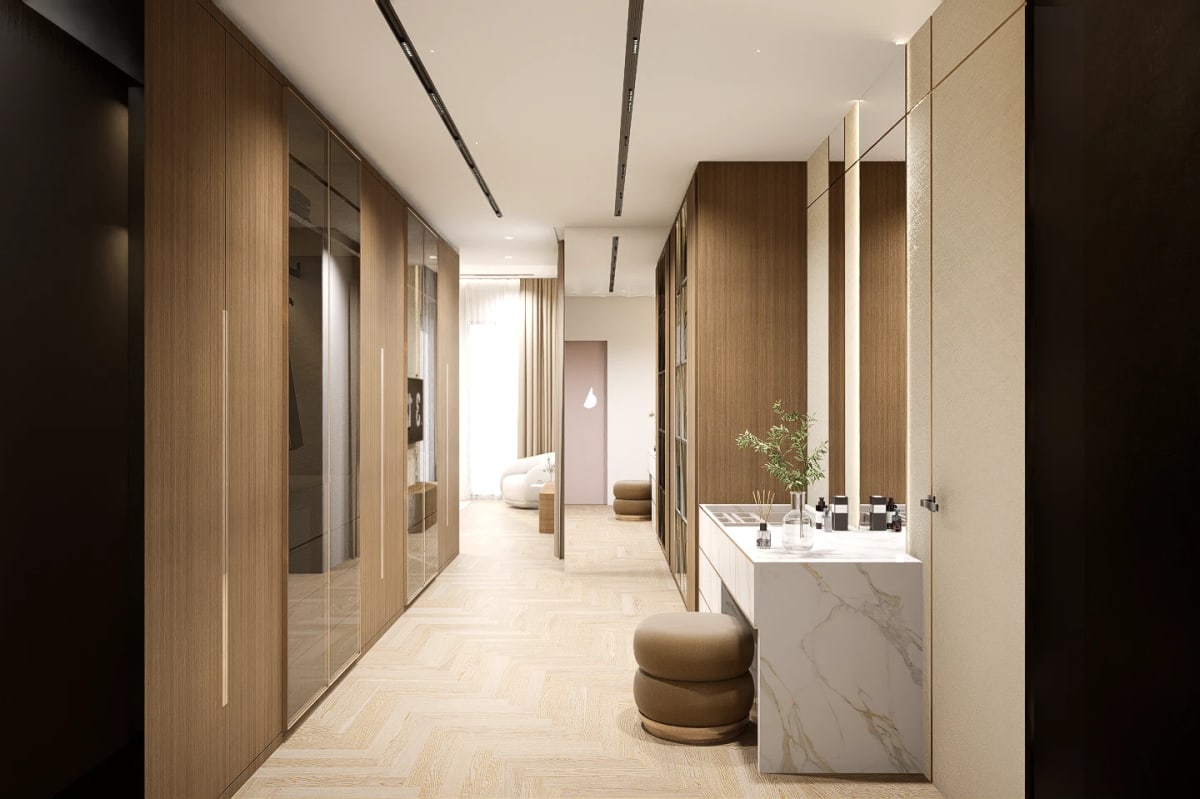
Joinery finishes for UAE interiors are one of the few decisions that quietly outlasts almost everything else in a room, since the cabinetry stays long after furniture and soft finishes are refreshed. Getting the choice right the first time is how a kitchen or wardrobe still reads as considered years on, rather than needing early rework because a finish was never suited to the space it went into. It is also, done thoughtfully, a chance to dubai-it: choosing a finish bold enough to carry a room rather than settling for whatever sample was easiest to source.
What Joinery Finishes Mean
A joinery finish is the surface material or coating applied to a cabinet door, panel, or piece of furniture, and it does two jobs at once: it sets the visual character of the piece and protects the substrate underneath from daily wear, moisture, and light. Veneer is a thin slice of real timber bonded to a stable substrate such as medium-density fibreboard (MDF), giving the natural grain and depth of solid wood with far less movement than a solid timber panel. Lacquer is a sprayed coating, usually applied over MDF, matched to almost any colour and finished matt, satin, or gloss, giving a smooth, seamless look with no visible grain or joins. HPL is a hard-wearing laminate sheet, manufactured under high pressure and heat and bonded to a board substrate, prized for resistance to scratches, heat, and moisture rather than a natural or bespoke appearance. Each is built differently, wears differently, and suits a different part of a UAE interior.
What UAE Interiors Ask of a Joinery Finish
Dubai and Abu Dhabi interiors put a finish through more than most. Direct sunlight through floor-to-ceiling glazing, common in open-plan villas and apartments, can fade or discolour some veneers and lacquers over time if UV-stable products are not specified from the outset. Constant air conditioning keeps indoor humidity low and stable relative to outside, generally kind to timber and veneer once the substrate is properly sealed, though transition zones near doors and balconies see more fluctuation and need a finish that tolerates it. Majlis and open entertaining spaces also mean finishes are seen up close under varied lighting, from daylight to warm evening light-emitting diode (LED) schemes, so a finish that reads well only under showroom lighting can disappoint once installed.
Because kitchens, wardrobes, and feature joinery are rarely replaced between owners in this market, the finish chosen at the outset does much of the work in how a property presents at resale, a point covered further in a broader look at premium interior finishes.
Joinery Finish Options for UAE Interiors
Natural Veneer for Warmth and Grain
Veneer brings genuine timber grain and depth to a piece, varying slightly panel to panel in a way that reads as considered rather than uniform. It suits feature walls, wardrobe fronts, and kitchen islands where warmth and texture matter more than absolute uniformity, and can be book-matched or slip-matched across a run for a continuous grain pattern. It needs a UV-stable lacquer topcoat in UAE interiors to resist fading from strong daylight.
Lacquer for Colour and a Seamless Look
Lacquer offers the widest colour range of the three and produces a smooth, joint-free surface that reads as a single continuous plane, particularly useful on large kitchen door runs or minimalist wardrobe fronts. A matt lacquer resists fingerprints and small marks better than gloss, while a high-gloss lacquer gives a sharper, more reflective look that shows dust and marks more readily.
HPL for High-Traffic Durability
HPL resists scratches, heat, and moisture better than veneer or lacquer, making it well suited to back-of-house cabinetry, utility rooms, and any joinery that takes heavy daily use. It comes in a wide range of woodgrain and solid-colour patterns that approximate the look of veneer or lacquer without matching their depth up close, so it tends to work best where durability outweighs the need for a bespoke appearance.
Matt vs Gloss as a Practical Choice, Not Just a Style One
Beyond colour, the sheen level of a lacquer or laminate changes how forgiving a surface is day to day. Matt and low-sheen finishes hide fingerprints, light scratches, and dust better, which matters on frequently touched surfaces such as kitchen doors and handles. Gloss finishes look sharper under directional lighting but show every mark, so they suit feature pieces that are seen more than touched.
Mixing Finishes Within One Room
A single room rarely needs to commit to one finish throughout. Pairing a veneer feature wall with lacquered cabinetry, or an HPL utility run behind a lacquered island, lets each finish do the job it suits best rather than forcing one material to cover every surface. The result usually reads as more considered than an all-one-finish room, provided the palette is coordinated rather than left to chance.
A Practical Framework for Choosing a Joinery Finish
- Discovery. Establish how each piece of joinery will be used, how often touched, and how much daylight the room receives.
- Survey. Note the room's orientation and glazing, since south- and west-facing rooms in the UAE see more direct sun exposure.
- Design. Shortlist finishes against the room's palette and lighting plan, coordinated with the wider interior design and build service so joinery, wall finishes, and lighting are chosen together.
- Materials. Confirm the substrate, UV stability, and moisture resistance of each shortlisted veneer, lacquer, or HPL option before committing.
- Fabrication. Produce and finish panels in a controlled environment so colour and sheen stay consistent across an entire run.
- Installation. Fit panels with attention to grain direction and joint lines, particularly for book-matched veneer.
- Handover. Provide cleaning and care guidance specific to the finish chosen, since veneer, lacquer, and HPL respond differently to cleaning products.
Common Challenges and Solutions
Sun exposure fading or discolouring veneer and lacquer over time.
Specify UV-stable coatings and, where a room receives heavy direct sun, consider HPL or a darker, more UV-tolerant finish for the most exposed surfaces.
A showroom sample looking different once installed.
View samples in the actual room under daylight and evening lighting before finalising a finish, rather than relying on one lighting condition.
Fingerprints and marks showing quickly on high-gloss lacquer.
Reserve high gloss for lower-touch feature pieces and specify matt or satin lacquer for handles and doors.
Matching a finish years later for a repair or extension.
Record the exact veneer cut, lacquer colour code, and laminate reference used, so future work can be matched rather than approximated.
Frequently Asked Questions
Which finish is most durable for daily use? HPL generally resists scratches, heat, and moisture best, making it well suited to high-traffic or utility areas, while veneer and lacquer suit surfaces that are seen more than heavily used.
Does veneer fade in direct sunlight? It can, particularly without a UV-stable topcoat, so rooms with strong daylight exposure need this specified from the outset.
Is lacquer available in a matt finish? Yes. Matt and satin lacquers are common and tend to hide fingerprints and light marks better than a high-gloss finish.
Can HPL look like real timber? HPL is available in woodgrain patterns that approximate timber, though it does not match the depth or natural variation of a genuine veneer up close.
Can different finishes be combined in one kitchen or wardrobe run?Yes. Combining finishes, such as a veneer feature panel with lacquered cabinetry, is common and often reads as more considered than a single finish throughout.
How should each finish be cleaned and maintained? Veneer needs a soft cloth and mild cleaner to protect the topcoat, lacquer benefits from non-abrasive products to avoid dulling the sheen, and HPL tolerates more frequent cleaning with standard household products.
The Surface That Has to Last
A joinery finish is rarely the most discussed decision in a project, but it is one of the longest-lived. Once a kitchen or wardrobe is installed, the finish is what a homeowner sees and touches every day for years, long after paint colours and furniture have moved on. Joinery finishes for UAE interiors deserve the same consideration as the layout or the hardware, chosen for how they will actually be used rather than how they look under a single showroom light. Hammer Group specifies and produces veneer, lacquer, and HPL joinery through its in-house joinery capability, with finish decisions shaped by projects such as a recent wood panelling and dining feature. Anyone weighing up a finish for a kitchen, wardrobe, or feature wall is welcome to get in touch to talk through the options.