
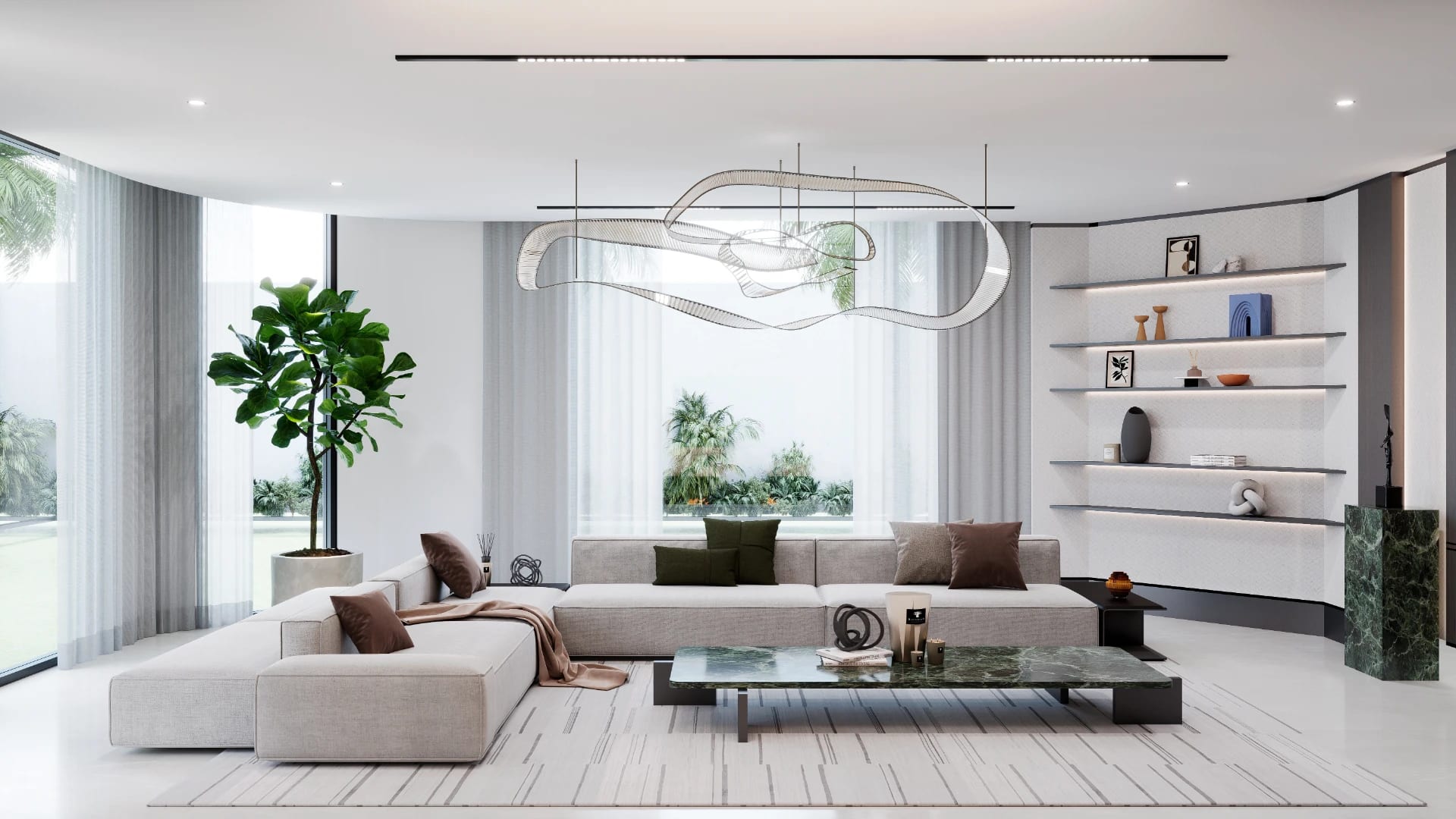
The living room is where most Dubai homes do their entertaining, their relaxing, and their quiet showing-off. It is also where clutter and mismatched furniture show up fastest. Thoughtful built-in living room joinery in Dubai homes solves both at once, turning a generous but generic space into one that feels designed rather than furnished. This is a room worth the ambition to dubai-it, letting built-ins do what loose furniture cannot. Cabinetry that follows the architecture, hides the practical, and frames the beautiful is what separates a styled room from a merely decorated one.
What Built-In Living Room Joinery Means
Built-in joinery refers to cabinetry and timber elements designed for a specific space and fixed permanently in place, rather than bought as freestanding furniture. In a living room, that includes media walls, display shelving, concealed storage, banquette seating, bar units, and panelling.
The difference from off-the-shelf furniture is precision. Bespoke living room cabinetry is measured to the millimetre, fitted wall to wall and often floor to ceiling, and finished to match a wider scheme. Because it is made to order, it can wrap around structural columns, absorb sloped ceilings, conceal air-conditioning grilles, and integrate lighting and cabling in ways a standalone unit never could. Good joinery is judged not only by how it looks on day one, but by how its doors close and how its hardware performs after years of daily use.
Why Built-In Joinery Matters for Dubai Living Rooms
Living rooms in the UAE carry a particular set of demands, and built-in joinery answers most of them directly.
- Entertaining is central. Whether it is a formal majlis or an open-plan family lounge, these rooms are made to host. Built-ins keep surfaces generous and clutter out of sight, so the space stays ready for company.
- Open-plan layouts need definition. Where living, dining, and kitchen run together, a media wall or part-height shelving run can zone the areas without closing them off.
- Storage has to disappear. Concealed and integrated storage absorbs cables, remotes, glassware, and toys behind clean, handleless fronts.
- The climate is unforgiving on poor materials. Constant air conditioning, humidity, and strong light test timber and finishes. Joinery specified for these conditions stays stable far longer than mass-market furniture.
- Prestige and resale reward quality. In a market where buyers notice finish levels, well-made fitted joinery signals a considered, high-specification home.
Built-In Joinery Ideas for Elegant Dubai Living Rooms
The strongest rooms usually combine two or three of these ideas rather than crowding in all of them.
Media Walls and Integrated Entertainment Units
The media wall has become the anchor of the modern Dubai living room. A full-height custom media wall brings the television, soundbar, and console storage into one composed surface. Cabling is routed inside and speakers can sit behind acoustically transparent panels, so the screen reads as part of the architecture rather than a black box on a stand. These feature walls and built-in joinery details are among the fastest ways to give a room a hotel-grade sense of order, an approach explored further in feature walls and built-in joinery.
Floor-to-Ceiling Display and Library Shelving
Floor-to-ceiling shelving for villas adds vertical drama and a curated home for books, art, and travel pieces. The trick is rhythm: a mix of open display bays and closed lower cabinets keeps the wall from feeling like a storage warehouse, while integrated LED (light-emitting diode) strips wash light across each shelf. Adjustable shelving lets the arrangement change over time.
Concealed and Integrated Storage
Some of the most valuable joinery is the kind you never notice. Concealed and integrated storage uses dead space behind sofas, beneath window seats, and along corridors. Push-to-open or handleless fronts keep the surface unbroken, so a long wall holds a surprising amount while still reading as a clean architectural plane.
Alcove, Niche and Majlis Seating
Dubai homes often have recesses created by structural columns or service shafts. Rather than fighting these, alcove and niche cabinetry fills them so the wall reads flush and intentional, with display above and closed storage below. Built-in majlis-style banquette seating suits the UAE's entertaining culture too: a run of upholstered seating fixed along a wall seats more people than scattered armchairs, and the base beneath doubles as storage.
Bar, Coffee and Feature Panelling
A built-in beverage or coffee station with a stone top, glass display, and a concealed fridge keeps entertaining self-contained and out of the kitchen. Closed, it reads as a handsome cabinet. Feature panelling, whether fluted timber, vertical battens, or shadow-gap detailing, adds texture and depth to a wall that flat plaster cannot, and gives the room a clear focal point.
A Practical Framework for Planning Built-In Living Room Joinery
A successful project follows a clear sequence. Skipping stages is where rework usually begins.
- Discovery and brief. Map how the room is used: who gathers there, how often you entertain, what needs storing, and where the television and seating should sit.
- Survey and space planning. A precise site survey records dimensions, levels, sockets, and AC grilles, feeding a layout that balances storage, display, and open space. Coordinating this with the wider layout and space planning keeps the joinery in proportion with adjoining rooms.
- Concept and design. Designers translate the brief into elevations, 3D visuals, and detailed drawings, the stage to test ideas before anything is cut.
- Materials and finishes. Choose carcasses, fronts, surfaces, and hardware together so they perform as a set, with the climate firmly in mind.
- Fabrication and coordination. The joinery is made in a controlled workshop, while electrical, lighting, AC, and audio-visual (AV) works, including MEP (mechanical, electrical, and plumbing) routing, are coordinated ahead of installation. Made-to-order bespoke joinery services cut, assemble, and finish each element to the approved drawings.
- Installation and handover. Trained fitters scribe units to walls and floors that are rarely square, adjust doors for consistent gaps, then a final walk-through checks alignment, finish, hardware, and lighting.
Delivering this through a single interior design and build services team keeps design intent intact from first sketch to final adjustment.
Best Practices
- Design to the architecture, not around the furniture, so cabinetry reads as part of the building.
- Plan storage by category first; the proportions of doors and drawers follow function.
- Choose hardware for daily life. Quality hinges and runners are felt every day and hard to upgrade later.
- Integrate lighting and cabling early, not as a retrofit.
- Keep the palette disciplined, two or three finishes repeated across the room.
- Leave breathing room so cabinetry does not feel heavy, balancing closed storage against open display.
Common Challenges and Solutions
Climate-driven movement and finish failure. Constant air conditioning and humidity warp poorly specified timber and peel cheap finishes. The solution is engineered substrates such as moisture-resistant MDF (medium-density fibreboard), quality edge-banding, and finishes rated for the conditions, all acclimatised before installation.
Out-of-square walls and uneven floors. Few rooms are perfectly true. Experienced fitters scribe units to the wall and use shadow gaps and filler panels that absorb tolerance rather than expose it.
Hidden services in the way. Sockets, switches, and AC grilles often sit where a cabinet should go. Early surveying lets the joinery be designed around them and relocate services before fabrication.
Overbuilding the room. Filling every wall leaves a space feeling boxed in. The fix is restraint at the design stage, balancing closed storage with open display.
Frequently Asked Questions
Is built-in joinery better than freestanding furniture for a living room?
For most Dubai living rooms, yes. Bespoke living room cabinetry uses space more efficiently, hides clutter more completely, and integrates with lighting and architecture in ways freestanding pieces cannot.
What materials suit built-in living room joinery in the UAE climate?
Engineered substrates such as moisture-resistant MDF and quality plywood, paired with durable surfaces like high-pressure laminate, veneer, or lacquer, and well-rated hardware, perform best under constant air conditioning and humidity.
Can built-in joinery work in an apartment, not just a villa?
Yes, and apartments often benefit most. Fitted joinery reclaims awkward recesses and dead corners that freestanding furniture wastes, making compact living rooms feel larger and tidier.
How does built-in joinery handle the television and audio-visual equipment?
A well-designed media wall integrates the screen, conceals cabling, ventilates equipment, and provides access for servicing, with speakers behind acoustically transparent panels so the wall stays clean.
Does built-in joinery add value to a Dubai home?
Quality fitted joinery signals a high-specification, well-considered interior, which tends to support resale appeal in a market where buyers notice finish levels.
Where the Elegance Comes From
Walk into a living room that simply works, and it is hard to say exactly why: the television is not the first thing you see, there is nowhere for clutter to gather, and every surface seems to belong. That ease is the doing of good built-in living room joinery in Dubai homes, which quietly handles the storage, the technology, and the proportions so the room is free to look effortless. It is the part of the design you stop noticing, in the best possible way.
If a fitted living room is on your mind, the Hammer Group team can look at your space, how you use it, and the materials you are drawn to, then design and make the joinery to suit. Ask for a concept for your room, see how it comes together in a recent living room project, or see sample finishes and details in the workshop before anything is built.