
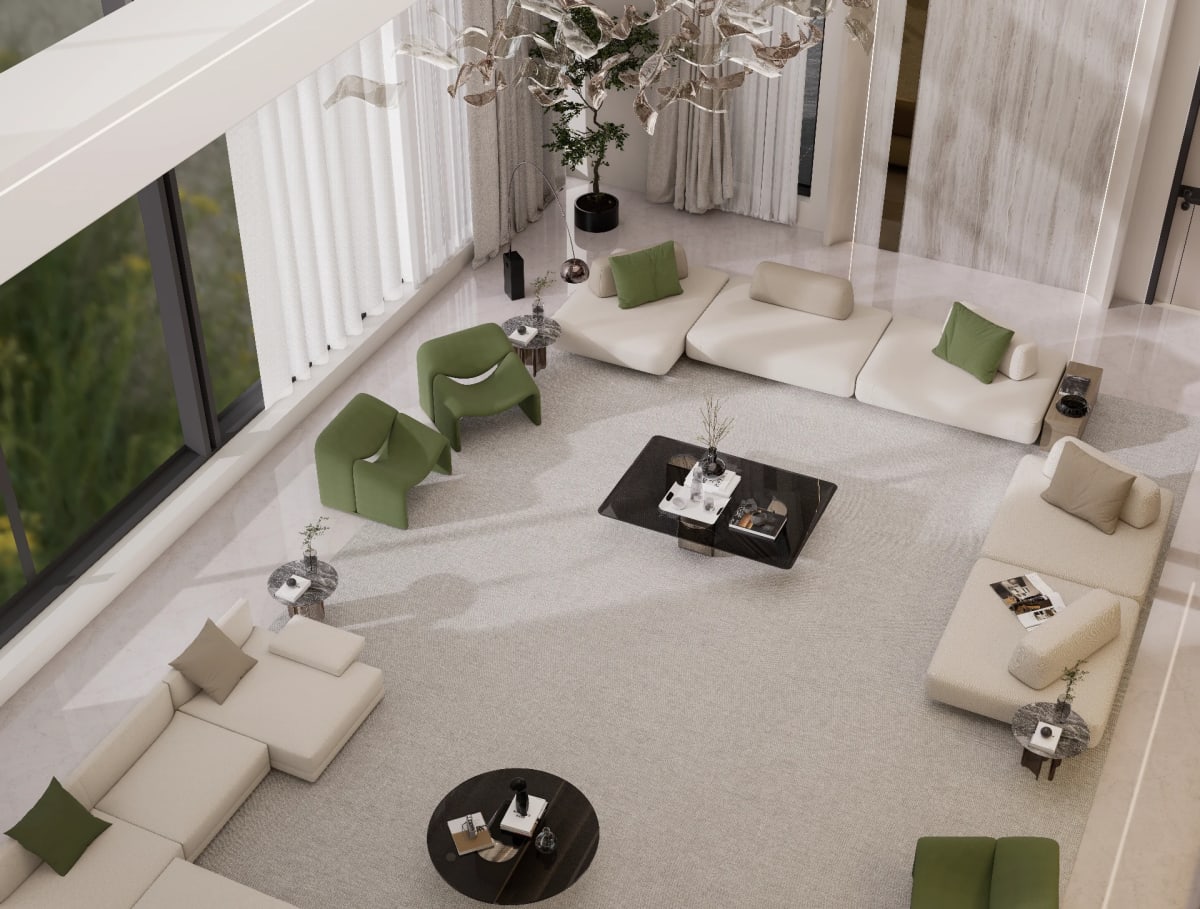
In many Emirati and Arab households, the majlis is the room a guest remembers. It is often the only space a visitor sees, and it is expected to speak for the family before anyone has said a word. Luxury majlis joinery in Dubai is how that first impression is made permanent, through walls, seating and service fittings designed for one room and no other. It is also a room where owners are happy to dubai-it, taking a traditional format and asking more of it than a row of sofas and a coffee table ever could.
What Majlis Joinery Actually Includes
Majlis joinery covers every fixed timber, panel and cabinet element in the room, drawn as a single scheme rather than ordered piece by piece. That typically means wall cladding, seating frames or platforms, service storage, display shelving, door surrounds and ceiling details. Each part is made to the room's measured dimensions, so junctions line up and the finished space reads as architecture rather than furniture.
A formal sitting room uses the same principles at a smaller, more contemporary scale. Where a majlis is usually arranged around its perimeter to receive larger groups, a formal sitting room tends to centre on one composed seating area. The joinery in both is there to set proportion, hold the practical items a host needs, and give the room a sense of occasion that loose furniture rarely achieves on its own.
What a UAE Majlis Asks of Its Joinery
A majlis works harder than most rooms in the house. It may host a family gathering at noon, a business visit in the afternoon and a celebration late into the evening, often with more guests than any other space is planned for. Joinery has to cope with that rhythm: durable finishes, robust hardware and storage that keeps the room ready at short notice.
Climate shapes every specification. Air conditioning runs for most of the year, humidity swings between seasons and fine dust settles into every open joint. Substrates such as moisture-resistant medium-density fibreboard (MR-MDF), carefully seasoned solid timber and properly sealed edges keep panels flat and doors true.
Prestige matters too. A well-resolved majlis adds to how a villa is perceived by guests and, later, by buyers. It also has to sit comfortably within the rest of the home, which is why the principles behind designing a villa lounge for relaxed conversation often carry across into the formal reception room.
Majlis and Formal Sitting Room Joinery Ideas
A Threshold Screen That Manages Sightlines
Many villas place the majlis near the front door so guests never pass through family areas. A joinery screen at the entrance, in lattice, slatted battens or solid panels with a carved border, controls what a visitor sees on arrival and what the household sees in return. Computer numerical control (CNC) routing allows geometric patterns to be cut with precise, repeatable edges, and the screen can double as a frame for the main door.
Fluted and Upholstered Wall Panels for Acoustics
A large majlis with stone floors and high ceilings can echo badly once twenty voices fill it. Alternating fluted timber panels (concave grooves cut into the face) with fabric-wrapped acoustic panels softens the sound without losing a formal look. The pattern can be set out to align with seating bays, so each section of wall feels deliberate rather than decorative filler.
A Service Wall Behind Pocket Doors
Rather than a freestanding coffee unit, the entire service function can sit within a wall of joinery. Pocket doors slide back into the panelling to reveal a stone worktop, drawers for cups and trays, a tray-height shelf for the dallah and space for dates and sweets. When guests arrive, the doors close and the wall reads as calm, continuous panelling again.
Ventilated Niches for Bakhoor and Oud
Burning bakhoor is part of welcoming guests in many homes, and the burner deserves a properly considered place. A recessed niche lined with stone or another heat-resistant surface, with a discreet vent above, keeps smoke and heat away from veneered surfaces. Soft light-emitting diode (LED) lighting inside the niche turns a practical fitting into a small focal point.
Raised Seating Platforms for Floor-Level Gatherings
Some households prefer the traditional floor-level majlis, with cushions arranged along the walls. A low timber platform defines that seating zone, lifts guests slightly off cool stone flooring and conceals deep drawers for spare cushions and textiles. The platform edge can be finished in solid hardwood or a metal trim to withstand constant foot traffic.
Folding Panels That Divide One Room Into Two
Where a single large majlis needs to host separate groups, full-height folding or sliding timber panels can split the space when required. Concealed top tracks and flush floor guides keep the room uncluttered when the panels are stacked away, and matching veneer means the open room still reads as one composition.
A Practical Framework for Planning Majlis Joinery
- Discovery. Establish who the room receives, how often, how refreshments are served and whether floor-level or raised seating suits the household.
- Survey. Measure the space as built, recording wall tolerances, ceiling heights, door swings and the positions of air-conditioning grilles and sockets.
- Design. Draw panelling, seating, service storage and lighting together, coordinated through an interior design and build service so ceilings, flooring and soft furnishings agree.
- Materials. Select veneers, solid timber, stone, metal trims and fabrics, confirming each suits humid, air-conditioned interiors.
- Fabrication. Produce panels, frames and cabinets in a controlled bespoke joinery workshop, with quality assurance (QA) checks before anything leaves the factory.
- Installation. Sequence fitting around flooring, wall finishes and mechanical, electrical, and plumbing (MEP) works, so joinery lands on prepared surfaces.
- Handover. Walk the household through pocket doors, lighting controls and niche ventilation, and explain how to care for each finish.
Best Practices
- Decide on seating type early, since it sets the depth of every wall element.
- Keep the service wall within easy reach of the host's usual seat.
- Plan sockets, lighting drivers and vents before panels are drawn.
- Repeat one or two materials across the room rather than introducing many.
- Use hard-wearing edges wherever guests will brush past or sit against joinery.
- Leave access panels for any equipment hidden in the walls.
Frequently Asked Questions
Should a majlis have built-in or freestanding seating?
Either works. Built-in frames and platforms make the most of perimeter walls, while freestanding sofas suit a smaller formal sitting room that may be rearranged.
How can a majlis stay formal without feeling cold?
Warm timber tones, textured panels, soft lighting and fabric-wrapped acoustic sections all add comfort while keeping the room composed.
Can a coffee station be hidden completely?
Yes. Pocket doors or flush hinged panels can conceal the whole service area, leaving only continuous panelling visible when it is closed.
Is it safe to burn bakhoor near timber joinery?
It is, provided the niche is lined with a heat-resistant material, ventilated and kept at a sensible distance from veneered faces.
Can one majlis serve two separate groups?
Folding or sliding full-height panels can divide a large room when needed and stack away neatly when it is used as a single space.
Which finishes suit a luxury majlis?
Veneered timber, solid hardwood, lacquer, natural stone and brushed metal trims are common, each specified for humid, air-conditioned conditions.
A Room Built Around the Guest
Every decision in a well-planned majlis comes back to the visitor: where they enter, where they sit, how quickly coffee reaches them and how the room sounds once conversation begins. Luxury majlis joinery in Dubai answers those questions in timber, stone and light, so the household can give its full attention to hospitality. For a sense of how bespoke furnishings and marble detailing come together in a finished home, a recent Al Barari villa interior shows the approach in practice. Hammer Group is happy to visit, understand how the room is used and propose joinery shaped around the people it will receive.