
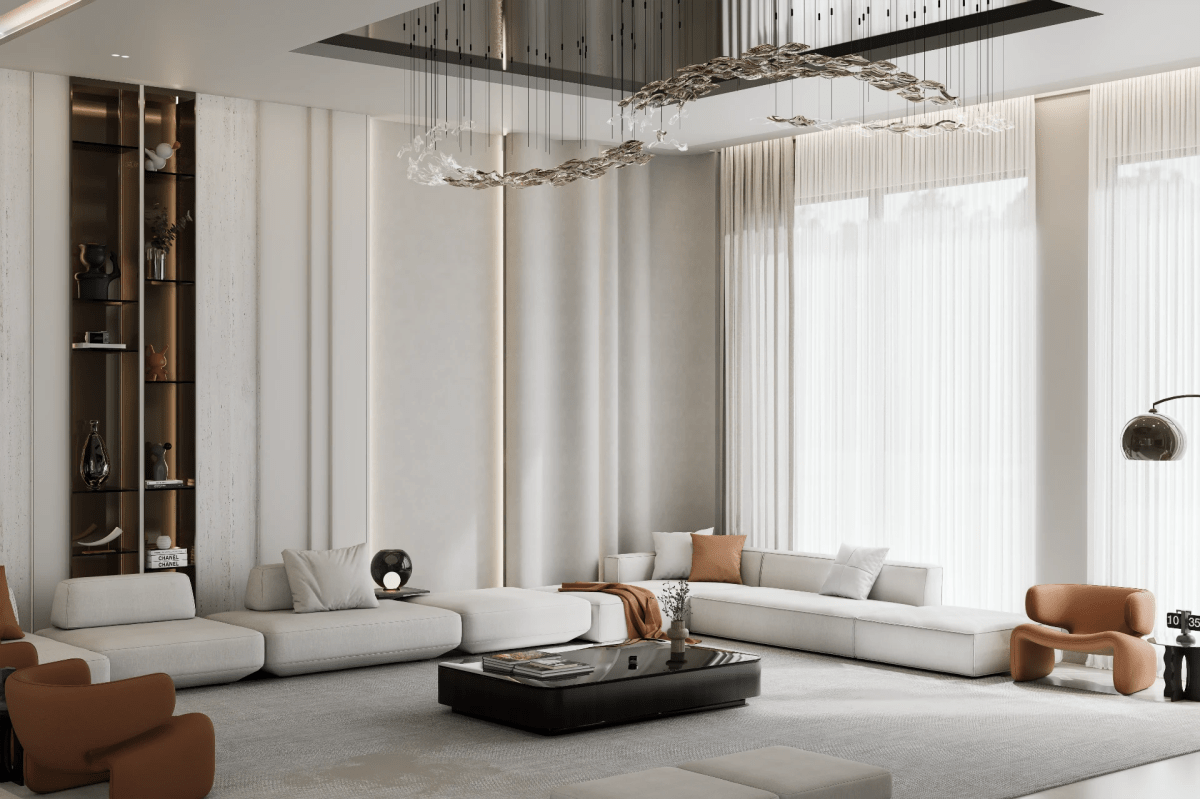
Custom majlis joinery shapes that impression through seating, service cabinetry and wall detailing, and it is a fitting place to dubai-it: to push a traditional room further than convention usually asks. Seating alcoves, coffee service units and lit display niches lead the ideas, and the planning sequence follows.
What Custom Joinery Means in a Majlis
Custom joinery in a majlis is cabinetry, panelling and built-in seating designed for one room and made to its exact dimensions. It can include banquette frames along the walls, service counters, feature wall cladding, display shelving, concealed audio-visual (AV) housings, doors and ceiling details. Each element is drawn to work with the others, so the room reads as a single composition rather than a collection of separate pieces.
A formal sitting room follows the same logic in a more contemporary key. Where the majlis is often arranged around the perimeter for larger gatherings, a formal sitting room may favour a smaller, more sculpted layout. In both cases, bespoke joinery gives the architect and the household control over proportions, finishes and detail that ready-made furniture cannot offer.
The Weight a Dubai Majlis Carries
A majlis carries more weight than an ordinary living room. It must seat many people comfortably, keep refreshments within easy reach of the host, and present a calm, generous face to visitors who may see no other part of the house. Family gatherings, business meetings and celebrations may all take place in the same space, so its joinery has to be durable, easy to maintain and considered in every corner.
Local conditions shape the detailing as well. Air conditioning runs almost constantly, humidity rises and falls across the seasons, and fine dust finds its way into every gap. Timber, veneer and hardware chosen for these conditions stay stable, while joinery that ignores them can warp or stick. Well-made joinery also adds to a home's standing and its appeal at resale, which is why so many owners commission rooms like this Palm Jumeirah living space designed and built with bespoke joinery.
Many new villas also place the majlis close to the entrance, sometimes with its own door and separate access, so that guests can be received without passing through private areas. That planning decision gives joinery a clear role: it can define the threshold, screen the transition to the rest of the house and keep the room feeling formal even when family life continues nearby.
Majlis and Formal Sitting Room Joinery Ideas
Perimeter Seating Alcoves and Banquette Frames
Joinery can frame the seating itself, with panelled backs, shaped headboards and recessed bays that give a long run of sofas a defined architectural edge. Seat bases can hold drawers for cushions, throws and occasional linen, and the depth of each alcove can be adjusted so guests sit comfortably without the room feeling crowded.
Coffee and Refreshment Service Units
A dedicated service unit lets the host serve without leaving the room. Typical features include a stone or solid-surface worktop, drawers for cups and trays, a concealed area for a coffee dallah, dates and sweets, and a discreet cupboard for glassware. Ventilation and a heat-resistant surface are worth planning early, since hot serving vessels will be set down here repeatedly.
Carved Panelling and Lattice Detailing
Geometric panelling inspired by traditional Arabic patterns gives a majlis cultural depth without turning it into a pastiche. Computer numerical control (CNC) cutting makes it possible to produce lattice screens and raised panels with crisp, repeatable edges, and the pattern can be scaled to suit the wall, the ceiling height and the size of the room.
Lit Display Niches and Cabinetry
Recessed niches with light-emitting diode (LED) lighting suit calligraphy, ceramics, family heirlooms and awards. Warm, dimmable lighting keeps the display gentle in the evening, and glass shelves with concealed drivers avoid visible fittings. Closed cabinetry below can hold the everyday items the room needs but should not display.
Concealed Media and Audio-Visual Integration
Many majlis also serve as a place to watch important events together. A media wall can hold a screen, speakers and equipment behind a door, a panel or a sliding front, so the technology is present when needed and invisible when it is not. Ventilation and cable routes should be resolved before fabrication begins.
Statement Doors and Ceiling Details
Tall double doors in veneer or lacquer, with fine metal inlays or carefully aligned grain, announce the room before anyone steps inside. Inside, coffered or stepped ceiling joinery with concealed lighting adds depth and draws the eye upward.
A Practical Framework for Majlis Joinery Projects
The sequence below mirrors the planning approach described in this guide to built-in joinery solutions for elegant living rooms in Dubai homes.
- Discovery. Establish how many guests the room usually receives, how refreshments are served, and how formal or contemporary the atmosphere should feel.
- Survey. Measure the room as built, noting wall tolerances, ceiling heights, door positions and the location of air-conditioning outlets and services.
- Design. Draw seating, service units, panelling and lighting as one composition, coordinated with the wider interior design and build service so finishes, ceilings and furniture agree.
- Materials. Choose veneers, solid timber, stone and metals that suit the palette and cope with humid, air-conditioned conditions, with moisture-resistant medium-density fibreboard (MR-MDF) carcasses where suitable.
- Fabrication. Build components in a controlled workshop, with every panel, drawer and door checked before it leaves the factory.
- Installation. Coordinate fitting with wall finishes, flooring and mechanical, electrical, and plumbing (MEP) services, so the joinery lands on prepared surfaces.
- Handover. Show the household how the service units, lighting controls and concealed housings work, and share finish care advice.
Common Challenges and Solutions
A large room with tall ceilings that feels cold or empty.
Layered panelling, cabinetry and ceiling detail, with warm lighting that breaks the height into human-scale zones.
Humidity and air-conditioning causing timber movement.
Stable engineered substrates, well-seasoned timber, sealed edges and finishes tested for local conditions.
Walls that are not perfectly straight.
A detailed site survey followed by made-to-measure panels and scribed edges, so the joinery meets the wall cleanly.
Technology that spoils a formal room.
Concealed AV housings, ventilated compartments and hidden cable routes built into the cabinetry.
Frequently Asked Questions
What is the difference between a majlis and a formal sitting room? A majlis is traditionally a large reception space for receiving guests, often with perimeter seating, while a formal sitting room is usually smaller and arranged more conventionally. Both benefit from tailored joinery.
Can seating be built into the joinery? Yes. Banquette frames, panelled backs and seat bases with storage can all be integrated, with upholstery added by a specialist.
Which materials suit a luxury majlis? Veneered timber, solid hardwood, stone, brass and lacquer are common choices, provided each is specified for air-conditioned, humid interiors.
Does a majlis need different joinery from a family living room?Usually, yes. A majlis is designed around receiving groups, so it needs more seating, dedicated service storage and a more formal finish, while a family living room is arranged around everyday use.
Can a majlis include a service area for coffee and refreshments?Yes. Custom service units with worktops, drawers, glassware storage and ventilation are a frequent request, and they keep the room tidy while guests are being received.
Can lighting and technology be hidden in the joinery? Yes. LED strips, niches, speakers and screens can all be housed within cabinetry, provided access and ventilation are planned in advance.
Where Hospitality Gets a Permanent Setting
A majlis that welcomes guests well has usually been planned as carefully as the meal served in it. Thoughtful custom majlis joinery gives seating, service and display a fixed and finished home, and it lets the household concentrate on the company rather than the room. If a majlis or formal sitting room is being planned or renewed, Hammer Group can survey the space, listen to how it is used, and propose joinery that suits both the family and the architecture.