
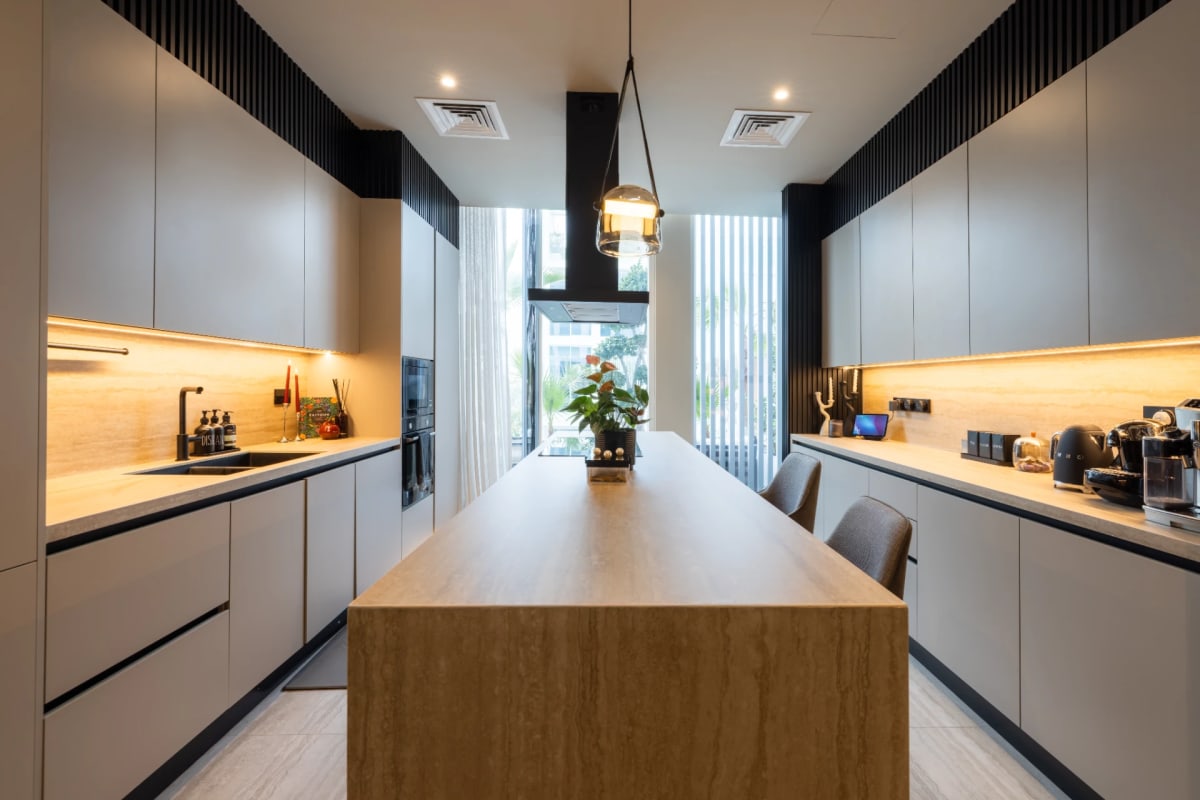
In a high-end villa, the kitchen is rarely just a place to cook. It is where families gather, where guests are entertained, and where the quality of the whole home is quietly judged. If there is one room worth an ambitious, no-compromise approach, this is it: the space to truly dubai-it, turning a bold vision into something you use every day. That is why custom kitchen joinery in Dubai has become a defining feature of luxury villa projects across the emirate. Bespoke cabinetry, tailored storage, and precision-crafted surfaces let a kitchen match the architecture around it rather than fight it, and the 2026 direction is clear: cleaner lines, richer materials, smarter interiors, and joinery built to hold up in the UAE climate.
What Custom Kitchen Joinery Means
Joinery is the crafted woodwork that forms the backbone of a kitchen: cabinets, drawers, islands, pantry units, and integrated storage. Custom, or bespoke, means each of these is designed and built for one specific space rather than pulled from a standard catalogue.
The difference is fundamental. Off-the-shelf units come in fixed sizes built on average assumptions. Custom joinery is shaped around the exact room, the way the household cooks, the appliances chosen, and the style of the villa, so every cabinet line, reveal, and corner resolves on purpose and nothing is forced to fit.
In a luxury villa, custom joinery usually covers full cabinetry layouts, bespoke islands and breakfast counters, concealed or walk-in pantries, integrated appliance housings, tailored internal storage, and continuous material runs that tie the kitchen to the living spaces beside it.
What a Dubai Villa Kitchen Has to Answer
Dubai's luxury villa market sets its own expectations, and they shape how kitchens are designed.
- Entertaining is central. Open-plan kitchens flow into dining and majlis areas, so the cabinetry has to look refined from every angle.
- Architecture sets a high bar. Contemporary villas run strong lines and premium finishes that standard cabinetry rarely keeps up with.
- The climate is demanding. Heat, humidity, and constant air conditioning can warp doors and lift finishes, so climate-appropriate specification is not optional.
- Prestige and resale. Buyers at this level read craftsmanship instantly, and a generic kitchen can undercut an otherwise exceptional property.
For these reasons the kitchen is rarely designed alone. It ties directly into the villa's wider interior design and build, so materials and detailing carry through from one room to the next.
Custom Kitchen Joinery Ideas for 2026
These are the directions shaping luxury villa kitchens this year. The best draw on a few of them with restraint rather than chasing every one.
Handleless, Minimalist Cabinetry
Flat, uninterrupted cabinet faces still lead high-end villa kitchens. Push-to-open mechanisms and recessed grip channels keep the surfaces clean, so open-plan spaces stay calm and the material and grain do the talking.
Mixed Materials and Natural Finishes
Single-material kitchens are giving way to layered pairings: warm timber veneers with matt lacquer, natural stone against muted cabinetry, and metal accents in brushed brass or blackened steel. Fluted and ribbed detailing adds texture and a sense of craft without leaning on colour.
Concealed Kitchens and Hidden Pantries
The quiet kitchen is among the strongest villa trends. Working zones and small appliances disappear behind full-height units or into a dedicated back-of-house pantry, leaving an immaculate show kitchen out front and a hardworking one behind it.
Statement Islands
The island stays the centrepiece and is turning more sculptural, with waterfall stone edges, contrasting materials, integrated seating, and storage built into the body. Lighting worked into it, from a soft plinth glow to task light over the surface, lets a well-designed island anchor the room for cooking and company alike.
Smart, Ergonomic Interiors
In a premium kitchen, how the joinery performs inside matters as much as how it looks outside. Custom drawer dividers, pull-out larders, clever corner units, deep pan drawers, and concealed appliance zones do the quiet work, holding every utensil and ingredient so the worktops stay clear. Getting the materials, hardware and finishes that keep a kitchen performing right is what makes bespoke joinery effortless to live with.
Climate-Smart, Durable Materials
For UAE villas, material choice is as much about performance as appearance. Moisture-resistant substrates such as MR-MDF (moisture-resistant medium-density fibreboard), quality edge sealing, and stable veneers keep a kitchen flawless for years, where lesser materials warp and lift under heat and humidity.
Matching Joinery to Your Villa's Architecture
A frequent mistake is designing the kitchen apart from the rest of the home. In a luxury villa, it should feel like a natural extension of the architecture around it. Contemporary villas with strong horizontal lines suit handleless cabinetry and continuous material runs, while classic or transitional homes carry framed detailing and warmer timber tones. High ceilings often call for full-height cabinetry or feature panelling so the kitchen is not lost in the volume of the space. When flooring, wall finishes, and joinery speak the same language, the kitchen reads as part of one considered interior.
A Practical Planning Framework
A premium result comes from a clear process, not guesswork.
- Discovery and brief. Establish how the kitchen will be used, who uses it, and which features matter most.
- Space planning and zoning. Divide the kitchen into prep, cooking, washing, storage, and serving zones for an efficient flow.
- Material and finish selection. Choose surfaces, finishes, and hardware together, balancing the look against climate suitability.
- Detailed design development. Turn the concept into precise drawings, resolving dimensions and appliance integration before anything is made.
- Precision fabrication. Through made-to-order bespoke joinery services, the cabinetry is manufactured to approved drawings in a controlled workshop for consistent quality.
- Installation and coordination. Fit the joinery on site in step with electrical, plumbing, and ventilation works, with MEP (mechanical, electrical, and plumbing) routing agreed in advance.
- Inspection and handover. Check alignment, soft-close function, and finish before handover.
Best Practices
- Design for real life, not just photos. A beautiful kitchen still has to be easy to cook in and clean.
- Specify for the climate first. Material performance in heat and humidity is what keeps a kitchen intact over the years.
- Keep proportions disciplined. Consistent reveals and aligned lines, composed from every angle, are what make joinery feel premium in an open villa.
- Integrate, don't decorate. Appliances, lighting, and storage should feel built in, not added on.
Common Challenges and Solutions
Material movement in the climate. Heat and humidity warp poorly specified board and lift finishes. Specify moisture-resistant substrates, stable veneers, and sealed edges, and acclimatise materials before installation.
Precision and coordination. Long cabinet runs and appliance integration go wrong when left to the site. Resolve them in shop drawings, coordinate with MEP works early, and install with careful levelling so dimensions and access are planned, not improvised.
Keeping the design cohesive. A kitchen can end up feeling separate from the home. Treat it as part of the wider interior, carrying finishes and detailing through from the adjoining living spaces.
Frequently Asked Questions
What is the difference between custom and standard kitchen joinery?
Standard joinery uses fixed-size units from a catalogue, while custom joinery is designed and built for your exact space, appliances, and lifestyle, so it fits precisely and feels fully integrated.
Is custom kitchen joinery suitable for the Dubai climate?
Yes, when the right materials are specified. Quality teams use moisture-resistant substrates and stable finishes built to handle heat, humidity, and constant air conditioning.
Can custom joinery match the rest of my villa's interior?
Absolutely. Finishes, detailing, and proportions can be coordinated with the wider interior so everything feels part of one design.
What materials work best for luxury kitchens in the UAE?
Stable timber veneers, quality lacquers, natural stone, and moisture-resistant cores are common choices, depending on the look you want and the performance the climate demands.
How do I keep a luxury kitchen looking flawless over time?
Durable finishes, well-engineered hardware, and thoughtful internal storage all help. Good joinery is built to perform under daily use, not just impress on day one.
The Detail That Sets a Villa Kitchen Apart
Strip away the marble and the appliances, and what makes a luxury kitchen feel luxurious is the joinery: the way a drawer glides, the run of grain across a cabinet, the pantry that hides the mess, and the island that draws everyone in. That is the quiet craft behind custom kitchen joinery in Dubai, and in 2026 it is what separates a kitchen that photographs well from one that genuinely works, year after year, in a demanding climate.
If a new villa kitchen or a rethink of an existing one is on your mind, the Hammer Group team can shape the cabinetry, storage, and finishes around how you actually cook and entertain, then make it in-house. Ask for a concept tailored to your kitchen, or see the craftsmanship up close in one of our recent kitchen joinery projects.