
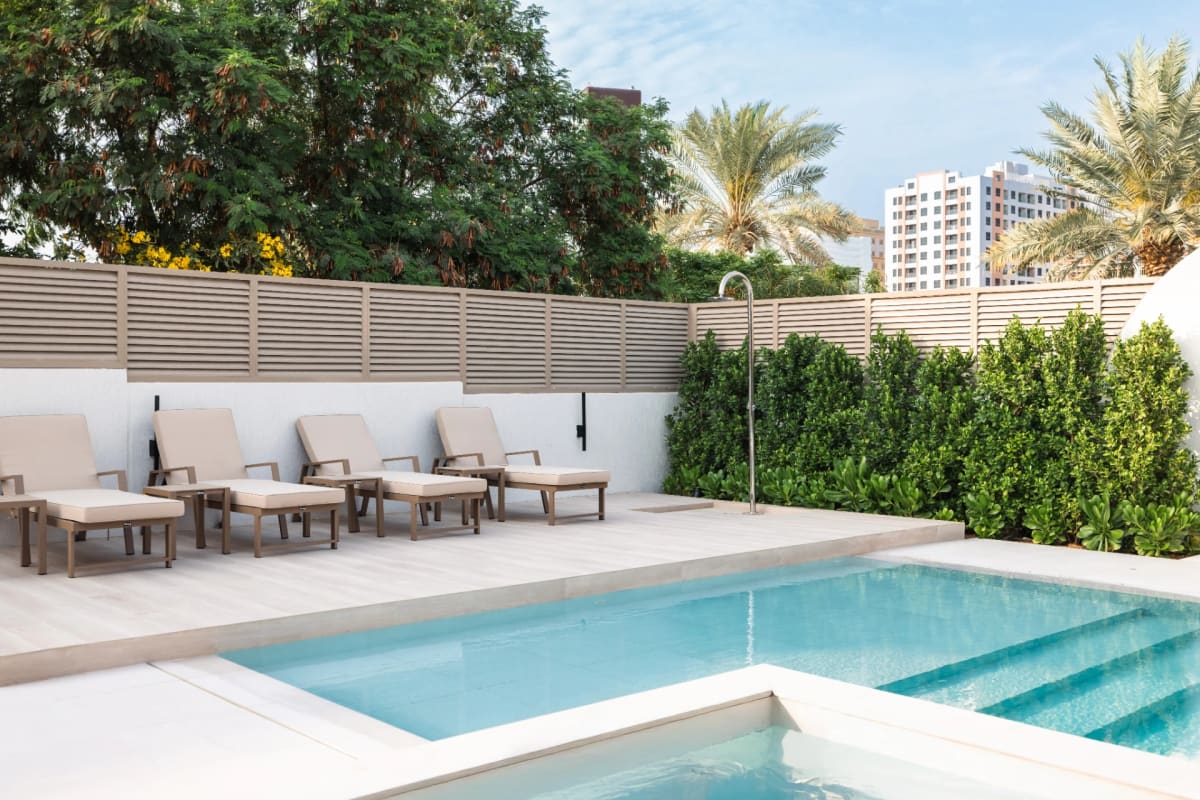
Luxury swimming pools are a defining feature of high-end villas across the UAE. However, creating a truly functional poolside environment requires more than an attractive pool and surrounding landscape. Well-planned luxury villa pool changing rooms provide privacy, comfort, and convenience while helping maintain a seamless connection between indoor and outdoor living spaces.
In Dubai and Abu Dhabi, these facilities must also respond to the regional climate, including intense sunlight, humidity, sand, and frequent exposure to water. Careful planning ensures that changing rooms, outdoor showers, bathrooms, and storage areas complement the villa’s architecture while remaining practical and durable.
Understanding Outdoor Changing Rooms and Pool Support Spaces
Outdoor changing rooms provide dedicated areas for residents and guests to change clothes, shower, and prepare for swimming without entering the main house. Pool support spaces extend these functions through additional amenities that improve the overall experience.
Depending on the villa’s layout and requirements, these spaces may include:
- Private changing rooms or individual changing cubicles.
- Outdoor showers and enclosed shower facilities.
- Poolside bathrooms and washbasins.
- Towel storage and concealed cabinetry.
- Lockable storage for personal belongings.
- Shaded seating and relaxation areas.
- Discreet storage for pool equipment and maintenance supplies.
Effective poolside support facilities design considers how these elements work together. The objective is to create an organised, comfortable environment that minimises wet traffic through the villa and provides convenient access to essential amenities.
Integrated or standalone facilities?
An integrated changing room positioned near the pool terrace can provide convenient access while maintaining a strong connection to the main residence. Alternatively, a standalone pool pavilion can offer additional privacy and create a separate destination within the garden.
The appropriate approach depends on the plot layout, architectural style, landscape design, privacy requirements, and intended use of the property.
Planning Luxury Villa Pool Changing Rooms
A successful design begins with understanding how residents and guests will move between the pool, changing areas, garden, and indoor living spaces.
Step 1: Assess the site and circulation
The location of the changing room should minimise unnecessary movement through the house. Wet users should be able to reach showers, bathrooms, and changing facilities without passing through bedrooms or formal living areas.
During the planning stage, consider:
- Direct and convenient access from the swimming pool.
- Clear separation between wet and dry circulation.
- Suitable access for cleaning and maintenance.
- Convenient connections to outdoor entertaining areas.
These considerations help improve everyday usability and protect internal finishes from water and sand.
Step 2: Prioritise privacy
Privacy is particularly important in luxury villas where family members and guests may use the pool simultaneously.
Changing rooms and showers should be positioned to avoid direct views from neighbouring properties, garden seating areas, and outdoor entertaining spaces. Architectural screens, recessed layouts, boundary walls, and carefully selected planting can help establish privacy without making the space feel enclosed.
For larger villas, separate changing areas may be appropriate. Smaller facilities can still provide comfort through a well-planned private changing room with an integrated shower and bathroom.
Step 3: Integrate showers and bathrooms
Well-designed outdoor shower and changing areas create a practical transition between swimming and indoor living.
Showers should be conveniently positioned near the pool, with changing areas and bathrooms accessible without obstructing circulation. Proper drainage, waterproofing, ventilation, and slip-resistant surfaces are essential to maintaining a safe and hygienic environment.
Selecting Materials for the UAE Climate
Material selection plays an important role in the performance and appearance of outdoor changing facilities.
The UAE’s climate exposes exterior finishes to strong UV radiation, high temperatures, humidity, dust, and pool chemicals. Materials must therefore be selected according to their intended exposure and maintenance requirements.
Flooring and drainage
Poolside flooring should provide appropriate slip resistance under wet conditions. Exterior-grade porcelain tiles, suitable natural stone, and purpose-designed outdoor finishes can be considered according to the project’s requirements.
Important considerations include:
- Effective drainage to prevent standing water.
- Correct floor gradients and carefully positioned drains.
- Reliable waterproofing beneath wet-area finishes.
- Safe transitions between indoor and outdoor flooring.
- Surfaces that can be cleaned and maintained easily.
Waterproofing and drainage should be coordinated before finishes are installed to reduce the risk of water ingress and deterioration.
Walls, cabinetry, and fixtures
Wall finishes and cabinetry should withstand repeated exposure to moisture and outdoor conditions. Materials and fittings must be appropriate for the specific environment, particularly where humidity and pool chemicals may accelerate corrosion or surface deterioration.
Natural stone, textured porcelain, timber-look finishes, and neutral colour palettes can create a sophisticated appearance while maintaining a connection with the villa’s architectural language.
Improving Comfort, Ventilation, and Lighting
Outdoor changing rooms must remain comfortable throughout their intended hours of use. Poor shading, insufficient ventilation, and unsuitable lighting can compromise even a visually impressive design.
Shade and thermal comfort
Pergolas, roof overhangs, recessed entrances, and architectural screens can reduce direct solar exposure while enhancing the overall appearance of the poolside environment.
Shade structures should be coordinated with the building’s architecture and landscape design to create a consistent visual experience.
Ventilation and moisture control
Enclosed changing rooms and bathrooms require appropriate ventilation to manage humidity, condensation, and odours. Depending on the layout, natural ventilation, mechanical extraction, or a combination of both may be suitable.
Electrical installations and lighting must also be appropriate for their location and comply with applicable safety requirements.
Functional and atmospheric lighting
Lighting should provide sufficient visibility for safe movement while maintaining a comfortable atmosphere after sunset.
Consider pathway lighting, mirror illumination, bathroom task lighting, and suitable exterior fixtures. The lighting design should complement the landscape and avoid unnecessary glare around the swimming pool.
Coordinating Architecture, Interior Fit-Out, and Landscaping
The most successful luxury villa pool facilities UAE projects are planned as part of a coordinated design rather than treated as separate additions.
Architectural planning establishes the layout, access, structure, and privacy. Interior fit-out defines the cabinetry, finishes, fixtures, and storage. Landscaping integrates planting, shade, pathways, and the surrounding outdoor environment.
These disciplines must work together to address drainage levels, waterproofing, irrigation, lighting, service routes, and maintenance access.
Explore our design and build Service solutions to understand how architecture, interior fit-out, and landscaping can be coordinated within a single project.
A coordinated approach can also help prevent common issues, such as irrigation affecting walls, planting obstructing drainage access, or poorly positioned equipment disrupting the finished landscape.
Design Inspiration and Ideas for Outdoor Pool Facilities
The design of a pool support space should reflect the villa’s architectural character, the needs of its occupants, and the surrounding landscape.
Some approaches worth considering include:
- Contemporary minimalism: Clean lines, understated finishes, concealed storage, and simple architectural forms.
- Natural-inspired design: Textured stone, warm neutral tones, and carefully selected planting.
- Resort-inspired spaces: Private changing rooms, shaded relaxation areas, and coordinated shower and bathroom facilities.
- Integrated garden pavilions: Separate structures that combine changing facilities with discreet storage and sheltered seating.
The goal is not simply to reproduce a luxury hotel aesthetic. Instead, the design should translate the desired atmosphere into a practical solution suited to the villa and its outdoor conditions.
Discover more luxury poolside design Ideas for inspiration on combining outdoor showers, changing rooms, and landscaped relaxation areas.
The phrase dubai-it can also be used informally to describe giving a space a distinctly Dubai-inspired luxury treatment. In practice, however, a successful design should go beyond visual impact and deliver privacy, durability, comfort, and practical everyday use.
Common Challenges and Practical Solutions
Insufficient privacy
Challenge: Changing rooms and showers are exposed to neighbouring properties or entertaining areas.
Solution: Review sightlines during the initial planning stage and use architectural screening, appropriate room positioning, and landscape planting to create privacy while preserving ventilation.
Poor drainage and water ingress
Challenge: Water accumulates around showers or moves towards the villa’s interior.
Solution: Coordinate floor levels, drainage gradients, waterproofing, and threshold details before installation begins.
Unsuitable materials
Challenge: Finishes deteriorate under sunlight, humidity, or repeated exposure to pool chemicals.
Solution: Specify materials suitable for their intended environment and consider maintenance requirements alongside appearance.
Disconnected design
Challenge: The changing room appears unrelated to the villa or surrounding garden.
Solution: Coordinate material palettes, architectural details, lighting, and landscape elements to create a consistent design language.
Best Practices for Successful Pool Support Facilities
Before finalising the design, assess the following considerations:
- Functionality: Are changing, showering, storage, and bathroom requirements addressed?
- Privacy: Are changing facilities appropriately screened?
- Circulation: Can users move between the pool and changing areas without disrupting indoor spaces?
- Climate suitability: Are materials, shading, and ventilation appropriate for the UAE?
- Water management: Are drainage and waterproofing properly coordinated?
- Safety: Are flooring, lighting, and electrical installations suitable for wet environments?
- Maintenance: Can drains, fixtures, and equipment be accessed and cleaned easily?
- Design integration: Do the facilities complement the architecture and landscaping?
For developers and project managers, reviewing these points during the design stage can help align the finished facility with the intended quality and functional requirements.
View our completed Project portfolio to explore how coordinated design and build solutions can bring architectural, interior, and landscape concepts together.
Frequently Asked Questions
What should luxury villa pool changing rooms include?
Depending on the property, they may include private changing areas, showers, bathrooms, towel storage, personal storage, and convenient access to the swimming pool.
Should a pool changing room be integrated into the villa?
An integrated facility can offer convenient access, while a standalone pavilion may provide greater privacy and separation from the main residence. The decision depends on the site layout and intended use.
Which flooring is suitable for outdoor changing areas?
Choose exterior flooring with appropriate slip resistance, durability, and maintenance characteristics. Correct installation, drainage, and waterproofing are equally important.
How can privacy be improved around outdoor showers?
Architectural screens, walls, recessed shower layouts, and carefully positioned planting can improve privacy while maintaining airflow and safe access.
How can pool support facilities be adapted to the UAE climate?
Appropriate materials, effective shading, moisture management, suitable ventilation, and coordinated drainage help outdoor facilities withstand local environmental conditions.
When should changing rooms be included in the design process?
They should be considered during the early planning stages alongside the pool, architecture, landscape, and building services. Early coordination helps resolve privacy, access, drainage, and maintenance requirements.
Well-planned luxury villa pool changing rooms contribute to a more comfortable, private, and functional outdoor living environment. Their success depends on balancing architectural quality with practical considerations, including material selection, drainage, ventilation, privacy, and long-term maintenance.
For luxury residential developments across Dubai, Abu Dhabi, and the wider UAE, coordinating architecture, interior fit-out, and landscaping from the outset can help create pool support facilities that complement the villa and its surroundings.
To explore suitable solutions for an upcoming residential project, consider consulting Hammer Group about integrating poolside facilities into the wider design and build approach.