
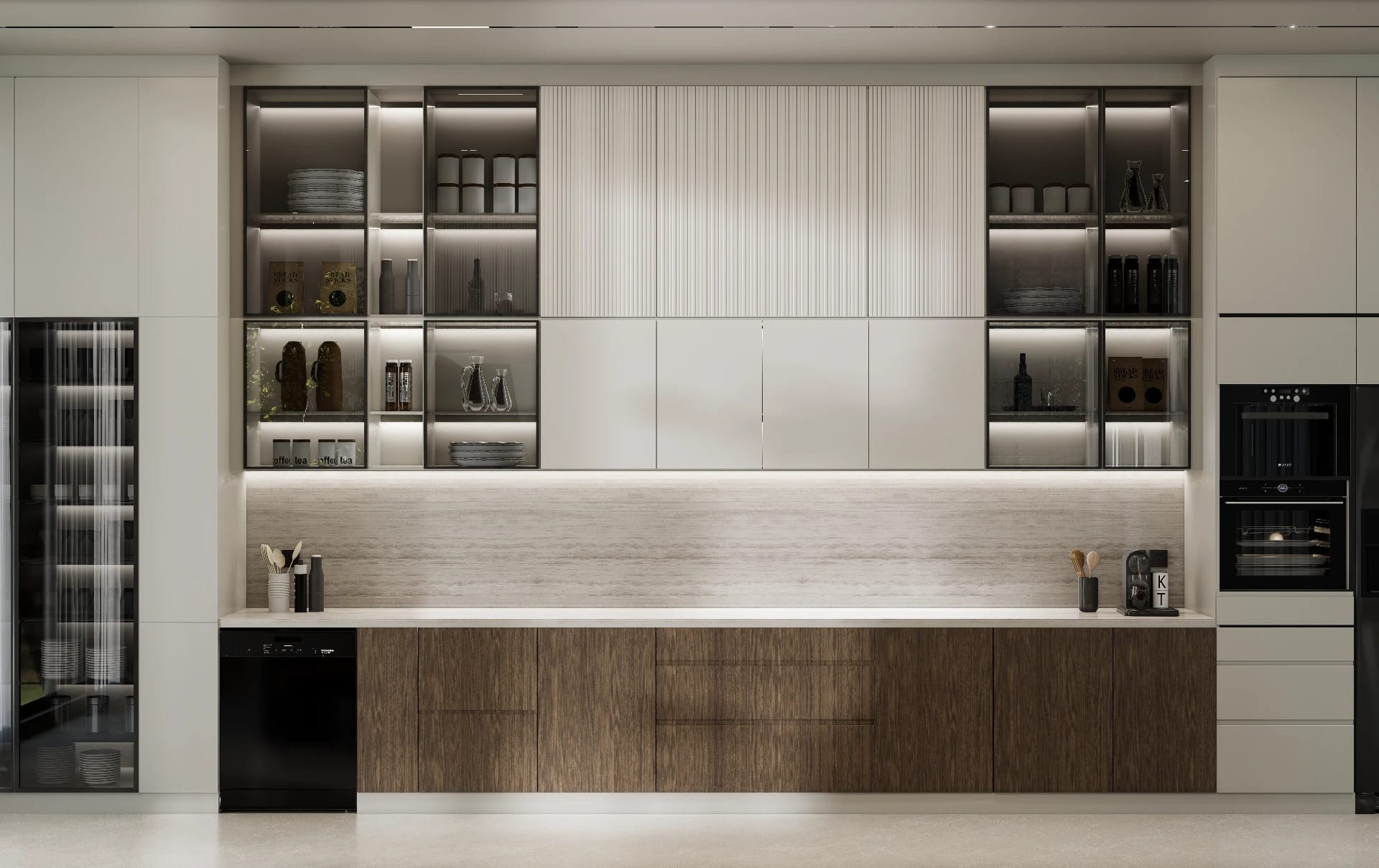
Villa owners across Dubai are rethinking what a kitchen, dressing room or media wall cabinet should actually look like, and the cabinetry trends shaping 2026 favour texture, concealment and craftsmanship over ornament. A homeowner who wants to genuinely dubai-it treats cabinetry as architecture rather than furniture, letting fronts, hardware and lighting carry as much visual weight as the walls around them.
What Cabinetry Trends Mean in 2026
Cabinetry trends describe the shift away from generic, showroom-standard units toward joinery designed specifically for one villa, one family and one set of daily habits. Instead of choosing a finish from a catalogue and fitting it wherever it happens to sit, designers now start with how a space is actually used and build the cabinetry around that behaviour. A pantry wall is planned around how a household cooks, not just how many boxes it can hide. A dressing room is planned around a wardrobe inventory, not a generic hanging-and-shelving ratio.
Materials have moved with this shift too. Medium-Density Fibreboard (MDF) remains the workhorse substrate for painted and lacquered fronts, while Moisture-Resistant MDF (MR-MDF) is now close to standard in kitchens, bathrooms and laundry areas where humidity is a daily reality. High-Pressure Laminate (HPL) continues to earn its place on high-traffic surfaces thanks to its resistance to scratching and fading. What has changed is how these materials are combined, layered and detailed, rather than which materials exist.
Why This Matters for Villas in Dubai
Villa cabinetry in Dubai answers to conditions that generic furniture never has to. Air conditioning keeps interiors comfortable, but it also creates constant, low-level shifts in humidity and temperature between rooms, cars, gardens and pool areas, and joinery has to be engineered for that movement rather than the mild swings seen in cooler climates. Strong natural light through large glazing means fronts and finishes need genuine fade resistance, not just an attractive showroom sample.
Villa scale changes the brief as well. A single kitchen run can stretch far longer than an apartment equivalent, a dressing room can rival a small bedroom, and open-plan living areas mean cabinetry is visible from multiple angles at once rather than tucked into one corner. That visibility raises the bar on detailing: mitred edges, consistent grain direction and flush reveals all read clearly in a large, light-filled room in a way they would not in a smaller footprint. Cabinetry has also become a genuine factor in resale value, since buyers touring a villa notice joinery quality almost as quickly as they notice layout.
Cabinetry Ideas Worth Considering
Fluted and Reeded Fronts
Vertical fluted or reeded detailing on kitchen islands, wardrobe doors and media units adds depth and shadow line without relying on colour or pattern. Reeded fronts use rounded, evenly spaced grooves, while fluted panels tend to have a slightly sharper profile, and the choice between the two usually comes down to how the light in that specific room will catch the surface.
Integrated Appliances and Concealed Handles
Refrigerators, dishwashers and even extraction systems are increasingly built behind matching cabinetry fronts, using push-to-open mechanisms or discreet channel handles so the run of units reads as one continuous surface. This suits open-plan kitchens where the cooking zone sits in full view of the living and dining areas.
Mixed Material Palettes
Rather than a single finish across every unit, 2026 kitchens and wardrobes are pairing timber veneer with stone, textured lacquer or metal detailing on select panels. A run of otherwise plain cabinetry gains presence from one accent material used sparingly, such as a fluted stone island base against flat lacquer wall units.
Warm Wood Tones Over Cool Whites
Warm oak, walnut and smoked timber veneers are replacing the stark white and grey palettes that dominated the previous decade. These tones photograph well against Dubai's strong natural light and soften the hard architectural lines common in newer villa developments.
Sculptural Islands and Free-Standing Units
Kitchen islands and dressing room centre units are being treated as standalone furniture pieces rather than extensions of the surrounding cabinetry run, often with a distinct base material, a waterfall edge or a curved profile that breaks up an otherwise rectilinear room.
Smart Storage Mechanisms
Soft-close drawers, internal pull-out larders, corner carousel units and vertical tie or accessory racks are now expected rather than optional, with hardware chosen for long-term reliability under daily use rather than novelty.
Practical Framework
1. Discovery – Understand how the household actually lives, cooks, dresses and entertains, along with any storage frustrations from the current home.
2. Survey – Measure the space precisely, checking wall alignment, services and structural constraints before any design work begins.
3. Design – Develop layouts, elevations and material boards, testing how proportions and finishes will read in the room's actual light.
4. Materials – Confirm substrates, veneers, hardware and finishes, balancing durability against the aesthetic direction agreed at design stage.
5. Fabrication – Cut, edge and assemble components under factory conditions, where tolerances are far tighter than they could be on site.
6. Installation – Fit units on site, aligning panels, adjusting hinges and confirming every drawer and door operates smoothly.
7. Handover – Walk the client through care instructions, warranty details and how to maintain finishes over time.
Best Practices
Work from a single fixed material board before fabrication starts, rather than approving finishes piece by piece, so the kitchen, wardrobes and media units feel like one considered scheme rather than several unrelated decisions. Specify hardware, such as soft-close hinges and drawer runners, from established manufacturers with a proven service history in the region, since replacement parts and warranty support matter more once cabinetry is fitted. Where a fluted or reeded front is used, confirm the groove direction and spacing against a physical sample in the room's own lighting, because a profile that looks right under showroom lighting can read very differently under UAE daylight.
Common Challenges and Solutions
A common issue is cabinetry that looks correct on a rendering but feels heavy or cramped once installed at full scale. The solution is a full-size mock-up or sample panel reviewed on site before fabrication proceeds, so proportions can be adjusted while changes are still inexpensive. Another frequent challenge is inconsistent finish quality across a long run of units, particularly with lacquer or veneer, which is best avoided by sourcing every panel from a single batch and a single fabrication run rather than combining orders from different suppliers. Humidity-related warping in kitchens and bathrooms is addressed by specifying MR-MDF and correctly sealed edges at every cut point, not only on visible surfaces, since unsealed internal edges are usually where moisture damage begins.
Frequently Asked Questions
What is the most requested cabinetry finish for villas in 2026?
Warm timber veneers, particularly oak and walnut tones, are the most requested finish, often paired with a textured or fluted accent panel on an island or feature wall.
Is fluted cabinetry difficult to keep clean?
Fluted and reeded surfaces collect slightly more dust in the grooves than a flat front, but a soft brush attachment during routine cleaning keeps them looking sharp with no special products required.
Can existing cabinetry be updated without a full replacement?
In many cases, yes. Replacing fronts, handles and worktops while retaining sound carcasses can refresh a kitchen or wardrobe significantly, though this depends on the condition of the existing units.
How long does bespoke villa cabinetry typically take from design to installation?
This varies by project scope and the number of rooms involved, so it is best confirmed once the design and material selections are finalised.
Do integrated appliances limit which brands can be used?
Most major appliance brands now offer integrated-ready models, so the choice usually comes down to matching panel thickness and hinge type rather than being restricted to one manufacturer.
Is mixing materials within one kitchen a passing trend?
Mixed palettes have held steady across several design cycles because they let a large run of cabinetry stay visually calm while still having a focal point, which suggests the approach has more staying power than a short-lived trend.
Ready to Bring These Ideas Into Your Villa?
Choosing the right cabinetry trends for a villa comes down to matching the ideas that suit your household with a fabrication process built for Dubai's climate and building standards. Hammer Group works through discovery, design and fabrication under one roof, so the finish you approve on a sample board is the finish that arrives on installation day. If you are planning a kitchen, dressing room or media wall refresh, our joinery team can talk through what these trends look like in your own space.
Related Reading
Explore our related insight: Custom Kitchen Joinery Ideas for Luxury Villas in Dubai 2026.
See our Interior Design & Build service for whole-villa interior projects.
Learn more about our Joinery Factory service for bespoke cabinetry fabrication.
View the case study: Modern Elegance in Craft, a custom cabinetry and kitchen project delivered by our joinery team.