
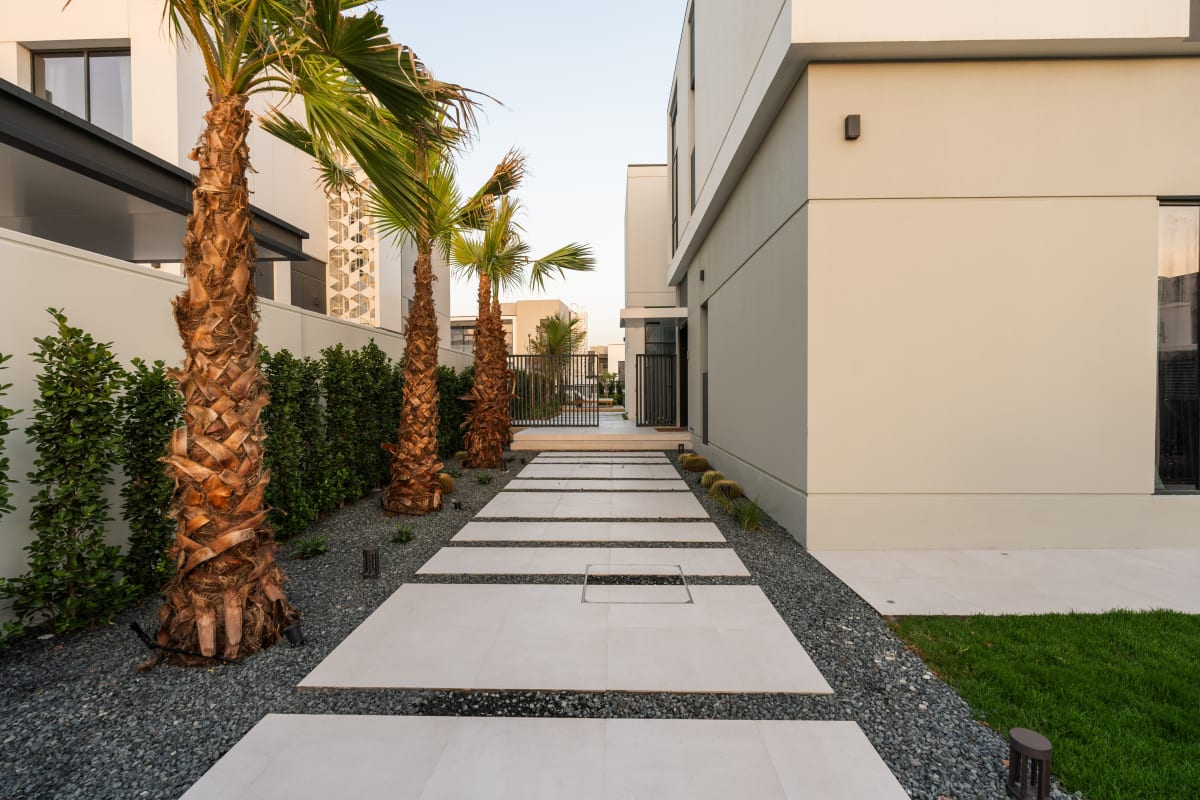
Natural stone can bring texture, permanence, and architectural character to a villa garden. In Dubai, where outdoor spaces often form an important extension of the home, stone can be used for pathways, walls, seating areas, steps, water features, planters, and focal points.
A considered Natural Stone Landscaping Dubai approach is not simply about adding stone to a garden. It involves selecting appropriate materials, coordinating colours and textures, and integrating hardscape elements with planting, lighting, architecture, and outdoor living areas. When carefully planned, natural stone can give a high-end landscape a cohesive and timeless appearance.
Why Natural Stone Works Well in Luxury Villa Landscapes
Natural stone has a distinctive visual quality because variations in colour, texture, grain, and surface finish create depth that manufactured materials may not always replicate.
For luxury villa gardens, stone can provide:
- Strong architectural definition
- Natural visual texture
- Durable hardscape surfaces
- Clear transitions between garden zones
- A connection between architecture and landscape
- Distinctive focal points
The key is to use stone selectively. A garden can quickly become visually heavy if every surface uses a different stone or finish.
1. Start With the Villa's Architectural Character
The strongest natural stone landscape design Dubai concepts begin by studying the architecture.
A contemporary villa may suit large-format stone, clean geometric paving, linear walls, and restrained detailing. A more traditional property may work better with textured stone, irregular paving, masonry features, or warmer natural tones.
Before selecting materials, consider:
- Exterior façade materials
- Existing paving
- Boundary walls
- Pool finishes
- Outdoor furniture
- Architectural colours
- Garden style
The landscape should feel connected to the villa rather than designed as an independent composition.
2. Use Stone Pathways to Structure the Garden
Pathways are one of the most practical applications for stone.
A well-designed path can guide movement while dividing the garden into distinct visual zones. Instead of treating the pathway as simply a route from one point to another, designers can use its width, alignment, material, and surrounding planting to influence the character of the entire garden.
Formal Pathways
Straight lines and regular stone modules work well in contemporary villa landscapes.
Informal Pathways
Irregular slabs or natural-looking arrangements can create a softer garden experience.
Stepping-Stone Paths
Individual stones placed within planting or gravel can provide a lighter visual intervention while maintaining a clear connection between spaces.
For a high-end garden, joints and transitions should be carefully resolved so that the stonework feels intentional and integrated.
3. Create Architectural Stone Walls
Stone walls can establish boundaries, define outdoor rooms, or create visual backdrops.
Possible applications include:
- Garden retaining walls
- Feature walls
- Seating walls
- Privacy structures
- Raised planting areas
- Outdoor kitchen backdrops
- Poolside architectural features
The choice of stone should respond to the scale of the wall. A large feature wall may require a material with enough variation to remain visually interesting without becoming distracting.
In contemporary gardens, stone walls can also be combined with timber, metal, glass, or planted areas to create contrast.
4. Introduce Stone as a Garden Focal Point
Not every stone feature needs to perform a structural function.
Individual boulders, sculptural stone formations, monolithic slabs, and carefully positioned natural elements can create focal points within planting compositions.
These stone features for villa gardens UAE projects work particularly well when they are given sufficient visual space.
Rather than placing multiple decorative stones throughout the garden, select a small number of meaningful focal points and position them according to sightlines from the villa, terraces, and outdoor seating areas.
5. Combine Stone With Water
Water and stone are natural design partners.
Stone can frame pools, fountains, streams, reflecting pools, and decorative water features. The contrast between a solid textured surface and moving water can create a calm visual effect.
For example, stone can be used to:
- Frame a water feature
- Create a raised fountain wall
- Define a pool edge
- Form stepping stones across shallow water
- Build a naturalistic water feature
- Provide a textured background for cascading water
6. Select Stone According to Its Application
Not every natural stone is suitable for every landscape application.
Selection should consider the intended use, exposure, maintenance requirements, surface characteristics, and relationship with surrounding materials.
Paving
Paving needs an appropriate surface finish and should be selected with pedestrian use and outdoor conditions in mind.
Walls
Wall materials can prioritise texture and visual character, particularly when used as architectural features.
Steps
Step surfaces require careful attention to dimensions, edges, transitions, and appropriate surface characteristics.
Decorative Features
Sculptural stones and boulders can be selected primarily for shape, colour, scale, and visual relationship with planting.
This application-based approach prevents material selection from being driven by appearance alone.
7. Coordinate Stone With Planting
Stone becomes more effective when it is balanced with greenery.
Planting can soften hardscape edges and create a transition between architectural surfaces and the garden. In Dubai, planting selection should also account for the local environment and the specific microclimate of the site.
Consider combining stone with:
- Architectural plants
- Grasses
- Groundcovers
- Shrubs
- Trees
- Seasonal planting
- Container plants
The contrast between stone texture and foliage can create depth without requiring excessive decorative elements.
This is a central principle of luxury stone landscaping UAE: the stone should contribute to the composition without overpowering the planting.
8. Integrate Stone Into Outdoor Living Areas
Luxury villa gardens often include multiple outdoor zones, including dining terraces, lounges, pool decks, fire features, and entertaining spaces.
Natural stone can help visually connect these areas.
For example, the same or complementary stone palette can be used across:
- Garden paths
- Outdoor steps
- Terrace edges
- Seating areas
- Planters
- Feature walls
Consistency does not mean every surface needs to be identical. Using related tones and textures can create continuity while allowing each outdoor zone to retain its own character.
For broader landscape planning, Luxury Villa Landscape Design UAE can support the integration of hardscape, planting, and outdoor living areas.
9. Use Lighting to Highlight Stone Features
Stone can change significantly in appearance under artificial lighting.
Landscape lighting can emphasise texture, create shadows, and highlight architectural forms after sunset.
Effective applications include:
- Uplighting feature walls
- Low-level path lighting
- Concealed lighting beneath seating
- Grazing light across textured stone
- Accent lighting around boulders
- Under-step illumination
Lighting should be carefully positioned to reveal texture without producing excessive glare.
A restrained lighting strategy can make a single stone wall or feature significantly more impactful than a garden filled with competing illuminated elements.
Common Challenges and Professional Solutions
Too Many Stone Types
Challenge: Combining several colours, textures, and stone formats can make the garden feel fragmented.
Solution: Establish a controlled material palette and repeat selected materials across different landscape zones.
Stone Overwhelming the Planting
Challenge: Extensive hardscape can make a garden feel rigid.
Solution: Use planting to soften edges and introduce variation around walls, paths, and seating areas.
Inconsistent Scale
Challenge: Small decorative stones may appear insignificant in a large villa garden, while oversized elements can dominate smaller spaces.
Solution: Select stone features according to the scale of the villa, garden, architecture, and surrounding planting.
Difficult Maintenance
Challenge: Certain stone arrangements can make cleaning, access, or planting maintenance more difficult.
Solution: Consider maintenance access and drainage during the initial landscape planning stage.
A Practical Natural Stone Landscape Framework
A structured approach can make material selection and landscape detailing more effective:
- Analyse the architecture – Identify existing materials, colours, forms, and proportions.
- Map the garden zones – Define entrances, paths, terraces, pools, planting areas, and outdoor rooms.
- Select a stone palette – Establish complementary materials rather than choosing each feature independently.
- Define focal points – Identify where stone walls, boulders, water features, or architectural details should attract attention.
- Coordinate planting – Balance hardscape with appropriate greenery and natural textures.
- Plan lighting and drainage – Resolve technical requirements alongside the visual design.
- Review the complete composition – Assess how the landscape looks from key viewpoints during both day and evening.
This framework helps transform individual stone elements into a cohesive landscape concept.
Frequently Asked Questions
What natural stone is suitable for villa landscaping?
The appropriate stone depends on its intended application, environmental exposure, surface requirements, maintenance considerations, and the overall landscape design. Different stones can be suitable for paving, walls, steps, or decorative features.
How can natural stone make a Dubai villa garden look more luxurious?
Careful material selection, precise detailing, appropriate scale, coordinated planting, and strategic lighting can give stone features a refined appearance without excessive decoration.
Can natural stone be used around swimming pools?
Yes, suitable stone can be incorporated around pools for paving, walls, steps, coping, and decorative features. The specific material and finish should be selected according to the intended application and pool environment.
Should natural stone match the villa exterior?
It does not need to match exactly. Complementary tones, textures, and proportions can create a stronger relationship between the architecture and landscape than an exact material match.
How can stone and plants be balanced?
Use stone to establish structure and planting to soften it. Greenery can frame walls, paths, seating areas, and decorative stone features while introducing colour and organic texture.
Is landscape lighting important for natural stone features?
Yes. Carefully positioned lighting can reveal texture and architectural form after dark. However, lighting should remain controlled so that individual features support rather than compete with one another.