
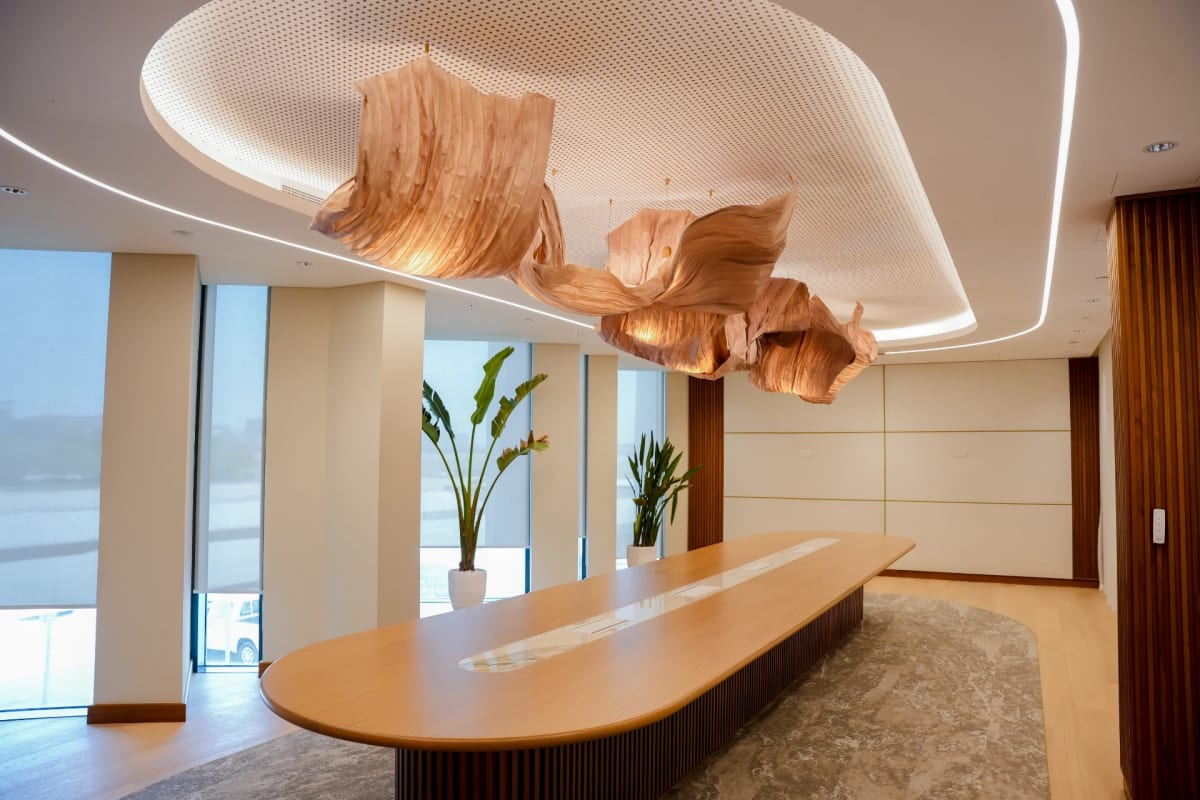
Sustainability is becoming an increasingly important consideration in commercial interior design and fit-out projects across the UAE. In Dubai, where offices, retail spaces, hospitality venues, and mixed-use developments demand high standards of design and functionality, material selection plays an important role in the long-term performance of a space.
Choosing sustainable commercial fit-out materials is not simply about selecting products labelled as environmentally friendly. A more considered approach looks at durability, sourcing, indoor environmental quality, maintenance, resource efficiency, and the potential for reuse or recycling.
For developers, business owners, and commercial property decision-makers, the objective is to select materials that support the design vision while also meeting practical and environmental requirements.
What Are Sustainable Commercial Fit-Out Materials?
Sustainable commercial fit-out materials are products selected with consideration for their environmental impact, performance, durability, and lifecycle.
Depending on the project, they may include:
- Responsibly sourced timber and engineered wood
- Materials containing recycled content
- Low-emission paints, adhesives, and sealants
- Durable flooring and wall finishes
- Modular or demountable partition systems
- Reusable or recyclable interior components
- Products supported by environmental and technical documentation
There is no single material that can be considered the most sustainable for every project. The right choice depends on how the space will be used, the expected level of traffic, maintenance requirements, design objectives, and technical specifications.
Why Material Selection Matters in Dubai Commercial Interiors?
Dubai’s commercial interiors are often expected to combine distinctive design with durability and practical performance. Materials need to withstand their intended environment while maintaining the visual quality expected from a professionally designed space.
For this reason, sustainable materials for commercial interiors should be assessed according to their actual application.
An office, for example, may require materials that support occupant comfort and indoor environmental quality, while a retail environment may place greater emphasis on durability, cleaning, and resistance to heavy foot traffic.
Durability and Long-Term Performance
One of the most important considerations when selecting materials is how they will perform over time.
A material that requires frequent replacement can result in additional consumption of resources and generate unnecessary waste. Durability should therefore be considered alongside environmental credentials.
Project teams can assess:
- Expected service life
- Resistance to daily use
- Cleaning requirements
- Maintenance needs
- Repairability
- Availability of replacement components
- Ability to adapt to future changes
A durable material that continues to perform effectively can contribute to a more responsible approach to commercial fit-out.
Indoor Environmental Quality
The materials used inside a commercial space can also influence the indoor environment.
Paints, adhesives, flooring systems, sealants, composite boards, and other finishes may release emissions into indoor air. Where appropriate, project teams can review product documentation and consider low-emission alternatives.
This can be particularly relevant in offices and workplaces where employees and visitors spend significant amounts of time indoors.
A Practical Framework for Sustainable Material Selection
Sustainable material selection becomes more effective when it follows a clear and consistent process.
1. Understand the Project Requirements
The first step is to establish what the material needs to achieve.
Consider:
- Type of commercial activity
- Occupancy levels
- Expected foot traffic
- Cleaning and maintenance requirements
- Brand and aesthetic requirements
- Acoustic performance
- Fire and safety requirements
- Expected frequency of refurbishment
A sustainable material that does not perform adequately in its intended application may not be an appropriate choice.
2. Review Environmental Credentials
Environmental claims should be supported by credible product information wherever possible.
Depending on the material, this may include:
- Environmental Product Declarations (EPDs)
- Recycled-content information
- Responsible sourcing certifications
- Product health information
- VOC or emissions information
- Manufacturer technical documentation
This helps project teams distinguish between documented environmental characteristics and broad marketing claims.
3. Consider the Full Material Lifecycle
A material should be evaluated beyond the point of installation.
Important questions include:
- Where is the material sourced?
- How is it manufactured?
- How long is it expected to last?
- What maintenance does it require?
- Can individual components be repaired or replaced?
- Can it be reused or recycled at the end of its useful life?
This lifecycle approach provides a more complete picture of the material’s environmental considerations.
4. Compare Suitable Alternatives
There is rarely one universally sustainable solution.
Instead, several suitable products can be compared according to environmental characteristics, technical performance, durability, maintenance, availability, and design requirements.
This approach allows the project team to make a balanced decision rather than selecting a material based on a single sustainability attribute.
Sustainable Materials Commonly Considered for Commercial Interiors
Different areas of a commercial fit-out require different material considerations.
Flooring
Commercial flooring often needs to withstand considerable daily use while maintaining its appearance.
Depending on the application, project teams may consider flooring products that offer recycled content, responsible sourcing credentials, long service life, or modular replacement options.
However, sustainability should be assessed alongside slip resistance, cleaning requirements, acoustic performance, durability, and maintenance.
Timber and Joinery
Timber and engineered wood products can add warmth and character to commercial interiors.
Where appropriate, responsible sourcing should be considered alongside durability, emissions, maintenance, and end-of-life potential.
The same principle applies to custom joinery: the material should be selected according to the project’s functional requirements rather than environmental claims alone.
Paints, Coatings, and Adhesives
Finishes are another important part of material selection.
Where suitable, low-emission paints, coatings, adhesives, and sealants can be considered to support indoor environmental quality.
Technical documentation should be reviewed to understand the actual characteristics and performance of each product.
Partitions and Ceiling Systems
Commercial spaces often need to change as businesses grow or operational requirements evolve.
Modular or demountable systems can provide greater flexibility in some applications because individual components may be modified, replaced, or reused without removing an entire system.
A well-planned commercial fit-out service can help integrate sustainable material selection with the project’s functional, aesthetic, and environmental requirements.
Common Challenges in Sustainable Fit-Out Projects
Selecting sustainable materials is not always straightforward. Several practical challenges can arise during design, specification, and procurement.
Balancing Sustainability and Design
Commercial interiors often have specific branding and aesthetic requirements. Materials therefore need to support the desired appearance while meeting technical and environmental objectives.
A practical solution is to assess several suitable alternatives rather than assuming that sustainable materials require a compromise in design quality.
Limited Product Information
Not every product comes with the same level of environmental documentation.
Project teams may encounter materials with broad sustainability claims but limited evidence to support them.
A more reliable approach is to request relevant technical and environmental documentation before approving materials.
Availability and Procurement
A specified product may not always be available in the required specification or quantity.
For this reason, it can be useful to identify acceptable alternatives based on clearly defined technical and environmental criteria.
This also helps maintain consistency if a material needs to be substituted during procurement.
Sustainability Versus Durability
A product marketed as environmentally friendly is not automatically suitable for every commercial application.
A material used in a high-traffic environment, for example, needs to meet appropriate durability and maintenance requirements.
Sustainability should therefore be considered together with service life, safety, performance, and suitability for the intended space.
Best Practices for Sustainable Material Selection
A practical approach to selecting eco-friendly fit-out materials Dubai projects can include the following:
- Establish sustainability criteria during the early design stages.
- Consider the intended application before selecting materials.
- Review environmental claims and supporting documentation.
- Prioritise durability in high-use areas.
- Consider low-emission products where appropriate.
- Reduce unnecessary material consumption.
- Consider modular and adaptable systems.
- Review maintenance and replacement requirements.
- Identify suitable alternatives before procurement.
- Document approved materials and specifications clearly.
These practices help make sustainability part of the project’s overall decision-making process rather than treating it as a separate specification exercise.
Sustainable Interior Fit-Out in Dubai
The UAE’s commercial environment brings together distinctive design expectations, demanding operating conditions, and a strong focus on quality.
As a result, sustainable interior fit-out Dubai strategies should be adapted to the individual building, commercial activity, and operational requirements of each project.
Material selection can also be considered alongside space planning, lighting, acoustic treatment, joinery, furniture, and other interior elements.
The aim is to create a cohesive interior where sustainability supports functionality and design rather than competing with them.
Looking at completed commercial fit-out projects can also help demonstrate how different sustainable materials perform across offices, retail spaces, and other commercial environments.
Sustainable Materials and Future-Focused Commercial Design
Sustainable design does not necessarily mean selecting the newest product or choosing anything marketed as “green.”
In many cases, a more responsible approach is based on straightforward principles: choosing durable materials, reducing unnecessary waste, considering responsible sourcing, verifying environmental information, and designing spaces that can adapt over time.
Adaptability is particularly relevant to commercial interiors. Businesses may change their layouts, departments, branding, or operational requirements over the years.
Materials and systems that allow parts of an interior to be repaired, replaced, or reconfigured can support greater flexibility and potentially reduce the need for complete refurbishment.
For businesses considering a more sustainable interior, practical design ideas can help balance material choices with functionality, durability, and the overall character of the space.
Frequently Asked Questions
What are sustainable commercial fit-out materials?
They are materials selected by considering factors such as environmental impact, durability, responsible sourcing, indoor emissions, resource use, maintenance, and end-of-life potential.
Are sustainable materials suitable for high-traffic commercial spaces?
Yes. Sustainable materials can be suitable for high-traffic environments when they meet the required technical, safety, durability, and maintenance specifications.
How can I verify whether a material is genuinely sustainable?
Review available environmental and technical documentation, such as EPDs, responsible sourcing information, recycled-content declarations, emissions data, and manufacturer specifications.
What sustainable materials can be used in Dubai commercial interiors?
Depending on the application, options may include responsibly sourced timber, recycled-content products, low-emission finishes, durable flooring, modular partitions, and other products with relevant environmental documentation.
Can an existing commercial interior be made more sustainable?
In many cases, yes. Opportunities may include reusing suitable existing components, selecting more durable replacement materials, choosing lower-emission finishes, improving adaptability, and reducing unnecessary material waste.
Does sustainable material selection affect the appearance of a commercial interior?
Not necessarily. Sustainability can be integrated with the project’s architectural concept, brand identity, colour palette, textures, and functional requirements.
Sustainable material selection is becoming an increasingly important consideration for commercial fit-out projects in Dubai. Rather than relying on environmental labels alone, project teams should assess materials according to their lifecycle, durability, technical performance, indoor environmental considerations, sourcing, maintenance, and potential for future reuse.
A well-considered approach starts during the early design stages and continues through specification, procurement, installation, and future maintenance.
For developers, business owners, and commercial property teams, the goal is not simply to select materials that appear sustainable, but to create interiors where responsible material choices work together with functionality, durability, and quality.
As commercial design continues to evolve in the UAE, thoughtful material selection can form an important part of creating interiors that are practical, adaptable, and more conscious of their long-term environmental impact.